
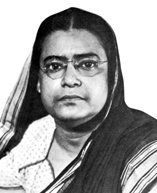
 Shamsunnahar Mahmud was a trailblazing Bengali writer, educationist, and politician who tirelessly championed women’s education and rights in early 20th-century Bengal. Born in 1908 into a progressive family, she navigated a society constrained by strict purdah customs to become a prominent figure in literature and public life. Her journey from a girl studying behind a curtain to a revered parliamentarian exemplifies a life dedicated to breaking barriers and empowering women.
Despite the social restrictions of her time, Mahmud’s passion for education was unwavering. At the age of nine, she was withdrawn from school to observe purdah, yet her determination led her to continue her studies at home with a tutor separated by a curtain. This early struggle for knowledge defined her career. She excelled academically, matriculating as a private candidate in 1926. With the crucial support of her husband, Dr. Wahiduddin Mahmud, she went on to earn her Intermediate Arts (I.A.) in 1928, her Bachelor of Arts in 1932, and a Master’s degree in Bengali literature in 1942. Her academic achievements laid the foundation for her later work and set an example for other women.
Mahmud’s literary career, which began at the age of ten, was devoted to highlighting the achievements of women and advocating for their rights. Her first major work, Punnyamayee (1925), featured biographical sketches of influential Muslim women, providing inspiring role models for her readers. Her most celebrated work, Rokeya Jibani (1937), was a definitive biography of her mentor, Begum Rokeya Sakhawat Hossain, a foundational figure in Bengali women’s education. This work remains a primary source for understanding Rokeya’s life. Mahmud also wrote about Mughal and Pathan women in Begum Mahal (1938) and produced a groundbreaking work on child education, Shishur Siksha (1939), which earned praise from Rabindranath Tagore. In 1933, she co-edited the literary magazine Bulbul, which became a vital platform for Bengali Muslim writers. Professionally, she served as a lecturer at Sakhawat Memorial Girls’ School and later became head of the Bengali Department at Lady Brabourne College in Calcutta, a college founded specifically for Muslim girls. After the 1947 partition, she continued her educational mission at Eden College in Dhaka.
Mahmud was a vocal and active advocate for women’s rights, serving as secretary of the Nikhil Banga Muslim Mahila Samity (All Bengal Muslim Women’s Society) and participating in numerous other organisations. She played a significant role in the struggle for women’s suffrage, leading efforts on behalf of the Nikhil Bharat Mahila Andolan when the Government of India Act of 1935 failed to grant women voting rights. For her immense contributions to education and social welfare, she was honoured with the title of MBE in 1944. Her political career was equally impactful. In 1962, she was elected to the National Assembly of Pakistan on a reserved seat for women, becoming one of only three women representatives from East Pakistan. As a parliamentarian, she championed women’s rights and was instrumental in drafting the Muslim Family Law in 1961, which aimed to improve women’s legal status. Her influence also extended internationally, as she represented East Pakistan at various global forums and served as the regional director for Asia in the International Friendship Organisation.