
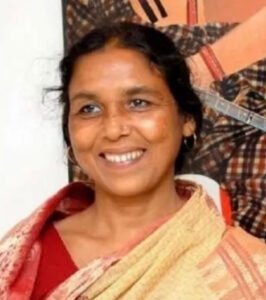
 Shakila Sheikh (born somewhere between 1969 and 1974) is a globally recognised contemporary Indian artist whose journey is frequently cited as one of the most compelling “rags-to-riches” narratives in South Asian art history. Rising from a childhood spent on the pavements of Kolkata to exhibiting in Paris, New York, and Hanover, Shakila is a self-taught prodigy who revolutionised the medium of collage. Her mentor, the late artist B.R. Panesar, famously described her not just as a creator but as a “living collage,” reflecting the intuitive, pieced-together nature of her survival and her art. She is celebrated for transforming the humblest materials—discarded newspapers and magazines—into sophisticated visual narratives that bridge rural simplicity with sharp socio-political commentary.
Early Life:
Shakila was born into extreme poverty in the late 1960s or early 1970s. Her father abandoned the family when she was an infant, leaving her mother, Zaheran Bibi, to support six children by selling vegetables on the footpaths of Kolkata’s Taltala market. It was here that she met B.R. Panesar, a philanthropist and artist known locally as “Dim-Babu” (Egg-Man) for distributing eggs and sweets to street children. Unlike other children, Shakila’s quiet refusal of handouts caught his attention, leading to a lifelong mentorship.
At the age of 12, Shakila was married to Akbar Sheikh, a vegetable vendor 15 years her senior, and moved to the village of Noorpur, approximately 64 kilometres from Kolkata. Struggling to make ends meet in a polygamous household, she returned to Panesar for aid. He provided her with old newspapers and glue to make ‘thongas‘ (paper bags) to sell to vendors. This utilitarian labour was her unintended apprenticeship; for hours daily, she manipulated paper, learning its texture, grain, and structural possibilities, laying the tactile foundation for her future art.
The Artistic Epiphany
Shakila’s transition from craftsperson to artist occurred in the late 1980s, following a visit to an exhibition of Panesar’s work at the Academy of Fine Arts in Kolkata. Shocked to see that “art” could be made from the same paper she used for grocery bags, she returned to her village and intuitively began pasting paper onto cardboard. Her first subjects were the vegetables that sustained her family—brinjals, tomatoes, and chillies. When she presented these initial efforts to Panesar, he was stunned by her innate grasp of composition and colour, immediately recognising her as a “born artist”.
Shakila’s technique is distinct from the European tradition of “cut and paste.” She does not use scissors. Instead, she tears the paper by hand, creating what Panesar termed an “anti-line”—a soft, fibrous edge that allows colours to bleed into one another, mimicking the blending of paint. She “hunts” through magazines for specific colours, using the printed material as a palette rather than a source of imagery, effectively “painting” with paper pulp and glossy prints. Her process is entirely intuitive; she creates no preparatory sketches, allowing the image to evolve organically as she pastes.
Shakila’s oeuvre has evolved in concentric circles. Her early works were pastoral, depicting the idyllic but hard life of rural Bengal: mud huts, ponds, and livestock. However, her subject matter eventually darkened to reflect contemporary realities. A recurring motif is the Hindu goddess Kali. Despite being a Muslim woman in a conservative society, Shakila depicts Kali as a symbol of “eternal motherhood” and strength, notably in the famous work ‘Kali Stopping the Train‘.
Post-2007, her work engaged with political violence (such as the Nandigram agitation) and violence against women. She has depicted grim scenes of women hanging from nooses and men selling eggs that look like bombs, using her art to voice the silent traumas of rural women.
Shakila’s first solo exhibition in 1991 was a commercial success, earning her Rs 70,000—a fortune that allowed her to build a brick house in her village, which was later designed by the renowned abstract artist Ganesh Haloi.
Her work has been exhibited in Paris, New York, Singapore, and Norway. A career-defining moment was her commission for the ‘Expo 2000 in Hanover, Germany’, where she created a massive installation of life-size papier-mâché figures representing rural women and the Grameen Bank.
Her recent exhibitions include:
2024 Retrospective: A major exhibition of her work, Shakila: Artworks from 1993-2024, was held at the Bihar Museum in 2024, which she attended in person.
2025 Exhibition: She had a solo retrospective titled Shakila – A Retrospective, held at the CIMA Gallery in Kolkata in April–May 2025.
She is the recipient of the ‘Sanskriti Award (2000)’, the ‘Charukala Award (2005)’, and a felicitation by the ‘Lalit Kala Akademi (2003)’. Shakila’s life and work were recently chronicled in the documentary ‘Shakila – The Collage of Struggle‘ (2024), cementing her legacy as a vernacular modernist who democratised the materials of high art.
Today, Shakila continues to work from her studio in Noorpur. The Centre of International Modern Art (CIMA) in Kolkata has been instrumental in managing her career and organising major retrospectives, including shows in 2024 and 2025.