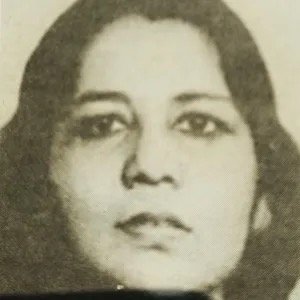
 Amina Ahmed Kar (1930–1994) stands as a pioneering figure in Indian modernism, uniquely balancing the roles of a radical abstract painter and a rigorous scholar of Southeast Asian culture. Born in Calcutta into an intellectually distinguished family—her father, Dr. Rafiuddin Ahmed, was the founder of modern dentistry in India—Amina displayed early brilliance. At just sixteen, her drawing Manmohan won first prize at the Academy of Fine Arts, placing her work alongside established masters of the era.
In 1949, Amina moved to Paris, a transition that fundamentally redefined her trajectory. For several years, she immersed herself in the European avant-garde, studying oil painting at the Académie Julian and graphic arts at Hayter’s Studio. Crucially, she worked in the studio of the Dutch artist César Domela, a former collaborator of Piet Mondrian. From Domela, she inherited a geometric discipline and a formal vocabulary that set her apart from the prevailing trends of Indian modernism. Simultaneously, she pursued deep academic interests at the Sorbonne and the École du Louvre, training under eminent Orientalists in Sanskrit Philology and Museology. It was in Paris that she met and married the celebrated sculptor Chintamoni Kar, beginning a partnership of mutual artistic respect, though she often worked in the shadow of his international fame.
Artistic Practice and Radical Abstraction
Kar’s mature artistic style resisted easy classification, existing in a “twilight zone” between the figurative and the non-figurative. Working across diverse media—including oil, acrylic, lithography, and etching—she developed a gestural, layered approach. Her canvases often featured dense surfaces from which fragmented female forms or enigmatic faces emerged, suggesting a deep, autobiographical meditation on identity and vulnerability.
Unlike many of her contemporaries who joined collective movements like the Progressive Artists’ Group, Kar maintained a fiercely independent path. Her work synthesized the geometric rigor of the De Stijl movement with the coloristic intensity of European modernism and the iconographic patterns she encountered through her scholarly research. Despite her independence, her work earned recognition at prestigious venues, including the National Gallery of Modern Art in New Delhi and Galerie Collette in Paris.
Scholarly Legacy and Historical Reassessment
Beyond the canvas, Kar made significant contributions to the field of Khmerology. Her primary intellectual legacy, The Angkorian Records (1977), was the result of exhaustive research into ancient Cambodian inscriptions. In this work, she proposed a provocative and well-substantiated hypothesis: that pre-Islamic Iranian culture had played a significant role in shaping Southeast Asian civilisation, alongside Indian and Chinese influences. This research opened fresh avenues for historians and solidified her reputation as a formidable academic.
The final years of Kar’s life were marked by increasing seclusion and struggles with mental health. While she continued to create, much of her output remained unfinished or hidden. Following her death in 1994, Chintamoni Kar worked to preserve her archive, discovering sketches tucked away in household account books. A major posthumous exhibition at Galerie 88 in 2001 sparked a critical reassessment of her career. Today, Amina Ahmed Kar is increasingly recognised not merely as a supportive spouse to a famous artist but as a trailblazing scholar-artist who bridged the gap between academic rigour and creative intuition.