
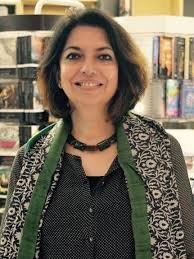
 Saba Hasan is a seminal Indian contemporary artist whose multidisciplinary practice spans over three decades. Distinguished by an intellectual rigour rooted in cultural anthropology, her work traverses painting, book sculptures, photography, film, and sound installations. Unlike artists who prioritise the aesthetic object, Hasan operates as a “visual anthropologist,” excavating personal and collective histories to explore themes of time, memory, truth (Haqeeqat), and the fragility of recorded knowledge.
Her oeuvre is defined by “organic conceptualism,” a process where she surrenders artistic control to natural elements—allowing rain, time, and decay to co-author her work. This approach creates a “whispered continuum” that stands in quiet subversion against the noise of contemporary media and the rigidity of historical absolutes.
Artistic Contributions:
Hasan’s contribution to the arts lies in her unique synthesis of the textual and the visceral. She deconstructs authoritative forms of knowledge (books, maps) to reveal the human vulnerability beneath.
1. The Book Sculptures
Hasan is critically acclaimed for her decade-long engagement with the “Book.” In her hands, books are not merely containers of information but “sculptural artefacts of memory and erasure”. She employs visceral methods such as burning, cutting, and “embalming” books with river stones, spices, and organic matter.
The Burnt Manuscript series and the Nine Book Installation (Sulehkul), which draw on Sufi philosophy. Her major solo exhibition, Jo ġāyab hai, aur hāzir bhi (That which is Absent, but also Present), at the Kiran Nadar Museum of Art (2025-26), showcased these works as totems of resilience against censorship and historical amnesia.
2. Painting and Materiality
Hasan’s early contribution to painting was the development of “relief paintings” in the 1990s. Born of economic necessity, she mixed cement with paint—a technique learned from masons—to create topographic, architectural textures that mimicked the urban decay of New Delhi. Over time, her palette expanded to include “paper, fabric, grass, tea, coffee, leaves, shells, and driftwood,” often gathered from specific geographic locations like the Great Wall of China or the ‘Jardin des Plantes’ in Paris, embedding the physical “DNA” of these places into her canvas.
3. Lens-Based Media
Her films and photographs are described as “tone poems” that challenge the linearity of time.
Key Projects: Walking in Deer Park is a photographic chronicle of a single park in Delhi spanning over twenty years, capturing the metaphysical cadence of nature. Her video project, Salsabil, creates “imaginary geographies” by blending footage of water bodies from Srinagar to the Danube, proposing a world where borders dissolve into a universal fluidity.
Family Background and Intellectual Lineage:
Saba Hasan’s art is deeply informed by a distinguished family background rooted in activism, literature, and academia.
She is the daughter of Ziaul Hasan, a committed communist and respected journalist who wrote for Patriot and Link, and was known as “the devil’s disciple” for his atheism. Her mother, ‘Tahera Hasan’ (née Siddiqi), was a translator and scriptwriter who worked for Kashmir radio. Through her mother, Hasan is related to the renowned scientist ‘Obaid Siddiqi’ (her maternal uncle), placing her in a family circle that included historians and intellectuals.
Her parents were alumni of Aligarh Muslim University (AMU) during the politically charged 1940s. They were students of Ismat Chughtai (the Urdu feminist writer) and Mohammad Habib (the Marxist historian), influences that instilled in Hasan a legacy of intellectual rebellion and feminism. She traces her lineage to the 16th-century Sufi itinerants Bandagi Shah Jamal and Bandagi Shah Kamal, which reflects the spiritual undercurrents in her work.
Her family often features directly in her art. She printed Urdu text on her mother’s sarees for the installation ‘The Silence From Which a Woman Speaks’, and her son, Aman Hasan, has composed music for her video works. She is married to Amit Kumar.
Honours, Awards, and Recognition:
Hasan’s work has been recognised by prestigious institutions globally, validating her proficiency across diverse media.
Major Grants and Fellowships:
-
Pollock-Krasner Foundation Grant (2022): A significant international grant awarded for her work in sculpture and mixed media.
-
Raza National Award for Painting (2005): Conferred by the Raza Foundation, linking her to the legacy of the Progressive Artists’ Group.
-
Fellowships: Syracuse University (Cultural Anthropology), French Cultural Ministry (Paris Residency, 2006), George Keyt Art Foundation (Sri Lanka, 2002), and the Oscar Kokoschka Academy (Salzburg, 2010).
Film and Photography Awards:
-
Best Screenplay Microfilms: FICIMAD, Madrid (2024).
-
Best Artist Short Film: Mannheim Arts and Film Festival, Germany (2023).
-
Honourable Mention: Moscow Foto Awards (2014) for Walking in Deer Park.
-
Finalist: Celeste Contemporary Art Prize, Milan (2013) for her video La Verite/Haqeeqat.
Notable Exhibitions:
-
Solo: Jo ġāyab hai, aur hāzir bhi at Kiran Nadar Museum of Art (2025-26).
-
Biennales: Her work was part of the Imago Mundi Collection at the 55th Venice Biennale (2013).
-
Collections: Her 38-page sketchbook on early Islamic science is part of the permanent collection at the Brooklyn Art Library, New York.
Saba Hasan’s body of work stands as a profound testament to the power of “quiet subversion.” Rooted in a deep literary and academic lineage that stretches back to the Progressive Writers’ Association, she has successfully translated the text-heavy heritage of her family into a visual language of silence, texture, and abstraction.
Her journey—from the economics classroom to the anthropology field site, and finally to the studio—has endowed her art with a rare intellectual rigour. Whether she is waiting for rain to paint her canvas, recording the silence of a park, or burning a book to save its soul, Saba Hasan remains a witness to the fragility of our times. As she navigates the “interconnected universe” of her practice, she continues to create a “new alphabet”—one composed not of letters but of ash, cement, water, and voice. In doing so, she ensures that while the physical book may burn, the “silence from which a woman speaks” will endure.