
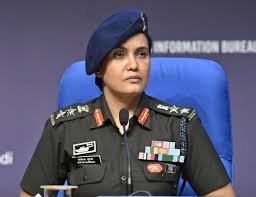
 Colonel Sophia Qureshi stands as a defining figure in the contemporary history of the Indian Army, bridging the gap between traditional martial heritage and 21st-century hybrid warfare. An officer of the Corps of Signals, she gained international recognition in 2016 as the first woman to lead an Indian Army contingent in a multinational exercise. In May 2025, she achieved national prominence as the strategic voice of Operation Sindoor, India’s decisive counter-terrorism response to the Pahalgam attacks. Her career reflects the Indian military’s evolution towards network-centric warfare and gender parity in command roles.
Colonel Qureshi is a third-generation officer whose family history is deeply entwined with India’s military narrative.
-
The 1857 Connection: During her 2025 media briefings, a revelation surfaced confirming that her great-grandmother was a warrior who fought alongside Rani Laxmibai of Jhansi during the Indian Rebellion of 1857. Colonel Qureshi has stated, “I have not heard lullabies; I have heard tales of bravery,” citing this lineage as her primary inspiration.
-
Post-Independence Service: Her grandfather served as a Religious Teacher (RT) in the Army, instilling spiritual discipline, while her father, Taj Mohammad Qureshi, served in the Corps of EME and fought in the 1971 Indo-Pak War.
-
The “Power Couple”: She is married to Colonel Tajuddin Bagewadi of the Mechanised Infantry. Their union represents national integration, blending her Gujarati heritage (Vadodara) with his roots in Karnataka (Konnur village). They have two children, with their son aspiring to join the Indian Air Force.
Early Career and UN Peacekeeping:
Born in 1974 in Vadodara, Sophia holds a Master’s degree in Biochemistry from MSU, Baroda. She abandoned a PhD to join the Officers Training Academy (OTA), commissioning into the Corps of Signals in 1999, shortly after the Kargil War.
-
Operation Parakram (2001-02): As a young Lieutenant, she served on the Punjab border during the massive mobilisation following the Parliament attacks, earning a GOC-in-C Commendation for maintaining critical communication links.
-
UN Mission in Congo (MONUC) (2006-09): She served as a Military Observer in the DRC, a role requiring immense diplomacy. She is credited with rescuing a five-year-old girl from a militia-controlled zone and monitoring volatile presidential elections. Her service earned her the UN Peacekeeping Medal and a commendation from the Force Commander.
Shattering the Glass Ceiling: Exercise Force 18:
In March 2016, Colonel Qureshi made history during Exercise Force 18, a multinational humanitarian mine action and peacekeeping exercise involving 18 ASEAN Plus nations. She was appointed to command the 40-member Indian training contingent, becoming the first woman officer to lead an Indian contingent in such a capacity. Notably, she was the only female commander among all 18 participating nations, including the US, China, and Russia. Her leadership was later cited by the Supreme Court of India as empirical evidence supporting the Permanent Commission for women officers.
Operation Sindoor (May 2025):
Colonel Qureshi’s career reached a strategic zenith during Operation Sindoor, launched in response to the Pahalgam terror attack that killed 26 civilians.
-
Operational Role: As a specialist in Signals Intelligence (SIGINT) and Cyber Warfare, she was integral to the operation’s command and control. The operation involved precision airstrikes on terror camps in PoK and Pakistan proper (May 7), followed by a second phase that neutralised Pakistani air defence radars in Lahore using electronic warfare and anti-radiation missiles.
-
Strategic Communication: The government selected Colonel Qureshi, alongside Foreign Secretary Vikram Misri and Wing Commander Vyomika Singh (IAF), to brief the world. Her briefing was a masterclass in information warfare; she used Flightradar24 data to expose how Pakistan kept the Karachi-Lahore air corridor open during hostilities, effectively using civil airliners as “human shields” against Indian air defence.
Honours and Recognitions:
Colonel Qureshi is a highly decorated officer. Her key awards include:
-
Sena Medal (Distinguished) (2025) for her role in Operation Sindoor.
-
Vishisht Seva Medal (VSM) (2019) for distinguished service in Signals modernisation.
-
COAS Plaque of Honour (2016) for leadership in Exercise Force 18.
-
UN Peacekeeping Medal and Global Peace Gandhi Award (2019).
Colonel Sophia Qureshi represents a new archetype of Indian military leadership: the “Warrior-Technocrat-Diplomat.” Her journey from the legacy of 1857 to the cyber-frontiers of 2025 exemplifies the Indian Army’s modernisation. By effectively managing the kinetic battlefield in the Corps of Signals and the information battlefield during national crises, she has cemented her legacy as a pivotal figure in India’s national security architecture.