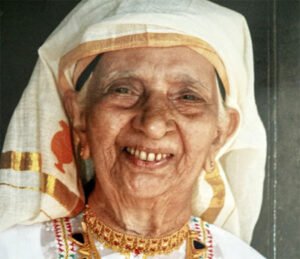
 Maliyekkal Mariyumma (1925–2022), affectionately known as “English Mariyumma,” was a seminal figure in the socio-educational landscape of Kerala’s Malabar region. As a social reformer and educational pioneer, she shattered deep-seated prejudices to become the first Muslim woman in Northern Kerala to receive a formal English education. Her life served as a vital bridge between the orthodox nineteenth-century Mappila ethos and the secular, progressive consciousness of modern India.
Mariyumma’s radical path was deeply rooted in her family’s progressive lineage. Born in Thalassery to Vazhail O.V. Abdullah (senior) and Manjumma, she was raised in a household where intellectualism and nationalism were daily discourse. Her father was a highly erudite commission agent and religious scholar, proficient in six languages. Both of her parents were active participants in the Khilafat Movement, instilling in her a sense of social duty and resistance to colonial constraints. The family’s ancestral home, the Maliyekkal House (or Tharavadu), was a grand double-storey mansion built in 1919. It served as a sanctuary for leaders of the Kerala Renaissance, hosting stalwarts such as Annie Besant, K.P. Kesava Menon, and A.V. Kuttimalu Amma.. This environment was significantly shaped by her grandmother, Puthiyamaliyakkal Kunhachumma, a social reformer who was the only woman from Kerala in the women’s wing of the All-India Muslim League in 1938. Kunhachumma received a “Recruitment Medal” from the Governor of Madras in 1945 for her contributions to recruiting unemployed youth during the Second World War.
The defining threshold of Mariyumma’s life occurred in 1938 when her father enrolled her in the Sacred Heart English Medium Convent School in Thalassery. At a time when English was widely derided by conservative sects as the “language of hell” (Naraka bhasha), this was a revolutionary act. Mariyumma was the lone Muslim girl among approximately 200 students. Her journey to school was fraught with intense hostility; community members frequently heckled her and even threw stones as she travelled in a hand-pulled rickshaw. To ensure her safety, her father made specific arrangements with the school to provide her with meals and a separate prayer room. Despite these trials and initial linguistic difficulties, she persevered and cleared the “fifth form”—equivalent to today’s secondary school certificate—in 1943. Her mastery of the language eventually transformed her nickname from a slur into a mark of distinction.
Following her 1943 marriage to V.R. Mayanali, who encouraged her continued studies, Mariyumma transitioned to institutional social reform. She became a leading figure in the Muslim Mahila Samajam, an organisation established in 1935, focused on women’s upliftment. Through this platform, she organised adult literacy classes and free tailoring sessions to provide women with vocational skills and financial independence. One of her most persistent interventions was her crusade against the dowry system, which she viewed as a social “evil” that impoverished families and diminished the status of women. She tirelessly campaigned for simplified marriage rituals and advocated for gender equality in all spheres of life.
Mariyumma’s intellectual influence extended to public speaking and the media. In 1970, she delivered a landmark speech in English on the necessity of Muslim women’s education at a meeting in Mananchira, Kozhikode, in the presence of the leader Sheikh Abdullah. Her articulation was further recognised in 1976 when she served as a judge to select announcers for the Kozhikode radio station. While she did not author traditional bibliographies, her life and oral histories have been meticulously documented in academic works on feminist historiography, such as J. Devika’s studies on gender and education in Kerala.