
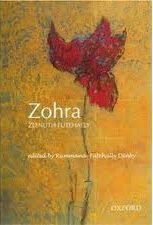
Zeenuth Futehally (1903/1904–1992) stands as a landmark figure in South Asian letters, recognised as one of the first Indian Muslim women to publish a novel in English. Her singular work of fiction, Zohra (1951), serves as a vital bridge between the feudal aristocracy of the late colonial era and the secular modernity of post-independence India. Set in early twentieth-century Hyderabad, the novel captures a vanishing world with a blend of romanticism, social critique, and ethnographic precision.
Family Background and Early Life
Born into the distinguished Tyabji-Futehally clan in the princely state of Hyderabad, Zeenuth belonged to a lineage often likened to the Tagores of Bengal for its profound influence on Indian intellectual and public life. Her father, Nawab Hashim Yaar Jung Bahadur, was honoured by the Nizam for his contributions to public health.
The Tyabji family, rooted in the reformist Sulaimani Bohra community, produced several iconic figures, including Badruddin Tyabji—the first Muslim president of the Indian National Congress—and the famed ornithologist Salim Ali. Growing up in an environment of intellectual ambition, Zeenuth was part of the first generation of Muslim women in her region to receive a formal education and step beyond purdah. She attended the Mehboobia Girls’ School in Hyderabad, where she mastered English and Urdu while developing a lifelong passion for the arts.
Zeenuth married Abdullah Nazar Mohammed Futehally at a young age. His career eventually took the couple to Japan, and it was there, far from home, that she began conceptualising a novel to document the aristocratic Muslim culture she sensed was rapidly disappearing. Most of her later life was spent in Mumbai, where she raised three children: Rafeeq, Jameela, and Rummana.
The Novel Zohra
Published in 1951 by Hind Kitabs, Zohra earned immediate acclaim. K.P.S. Menon, India’s first Foreign Secretary, noted in the preface that the heroine was caught between “two worlds / The one dead, the other yet unborn.” Even E.M. Forster endorsed the manuscript, praising the protagonist as “both convincing and charming.”
The narrative follows Zohra, a gifted woman bound by purdah and forced into an unhappy marriage with an older man, Bashir. Her intellectual and emotional journey mirrors India’s own struggle for self-determination. Her deepest connection is with her brother-in-law, Hamid, a Gandhian nationalist; however, their love remains unspoken. Zohra eventually finds purpose in social work, but her life ends prematurely after she contracts the plague—a conclusion that symbolises the insurmountable social constraints of her time.
Futehally’s realist style is saturated with the textures of Hyderabadi life. Her critique of purdah and her depiction of forbidden love as a catalyst for political awakening place the novel within a significant tradition of feminist dissent, anticipating much of later South Asian women’s writing.
Reception and Legacy
For decades, Zohra remained out of print until it was championed by Futehally’s daughter, Rummana Futehally Denby. Revised editions were released by Oxford University Press in 2004 and Zubaan in 2012, cementing the book’s place in the Indian English canon. Scholars now view the novel through postcolonial and feminist lenses, recognising it as a crucial link in the history of the South Asian novel.
Zeenuth Futehally died in Mumbai in 1992. Though her published output was slender, her voice remains an irreplaceable testament to a liminal generation of educated Muslim women who navigated tradition and modernity on their own terms.