
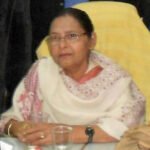
 Dr Naushaba Sardar is a distinguished contemporary Urdu scholar, literary critic, and academician whose career is deeply rooted in the Department of Urdu at the University of Allahabad. Established in 1924, this department is one of India’s oldest and most significant centres for Urdu studies, often referred to as the “Oxford of the East.” Sardar built her academic vocation within a formidable intellectual tradition shaped by luminaries such as Prof. Ejaz Husain and Prof. Gyan Chand Jain. Her scholarly profile is defined by a dual competence in classical poetic conventions—requiring a command of Arabic and Persian—and modern critical theory. Over her tenure, she rose to the rank of Professor and eventually served as the Head of the Department.
Contributions to Urdu Literary Criticism
Sardar’s primary scholarly achievement is her monumental research treatise, Beeswin Sadi Mein Urdu Tanqeed Ka Irtiqa (The Evolution of Urdu Criticism in the Twentieth Century). This extensive volume provides a systematic, historically organised analysis of the critical movements that defined Urdu literary thought throughout the 1900s. Her work meticulously traces the transition from the impressionistic criticism of the late nineteenth century to the ideological shifts of the Aligarh Movement.
Furthermore, she documents the rise of Marxist and Progressive frameworks associated with figures such as Ehtesham Husain and Sajjad Zaheer, eventually moving into modernist approaches in the century’s later decades. Rather than advocating for a single school of thought, Sardar’s methodology focuses on documenting the theoretical premises and socio-literary conditions of various critics. The significance of this work is underscored by its inclusion in the Government of India parliamentary records and its wide distribution to university libraries as a foundational resource for promoting Urdu literature.
Academic Leadership and Specialised Research
Beyond her work on literary criticism, Dr Sardar has maintained an active research presence in the study of the qaseeda, a formal panegyric genre. Despite its deep roots in Mughal court traditions, the qaseeda has been relatively neglected in modern scholarship; Sardar’s lectures and papers have worked to bridge this gap. Her influence extends beyond her own writing; she has served as a vital resource person for UGC-sponsored refresher courses and seminars across northern India, disseminating the scholarly culture of Allahabad to a broader academic audience.
As an educator and doctoral supervisor, she has guided a new generation of scholars through rigorous research frameworks at a time when institutional support for Urdu higher education faces significant pressure. Collaborating with colleagues such as Prof. S. M. Aqeel Rizvi and Prof. A. A. Fatmi, she helped maintain the department’s reputation for analytical excellence. Ultimately, Dr Naushaba Sardar’s legacy lies in her ability to systematise Urdu literary criticism as a serious academic discipline. Her work remains a meticulous and broad historical record, ensuring that the evolution of Urdu critical thought is preserved with the same analytical seriousness as any global branch of literary theory.