
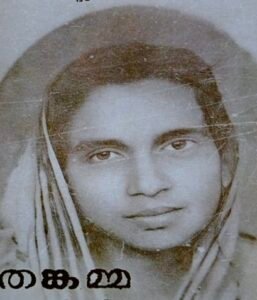
 Born in 1917 in Konni, Kerala, Thankamma Malik was a pioneering bilingual writer and social reformer whose life bridged the cultural landscapes of South and North India. Raised in a Christian household that valued education, she displayed an early aptitude for Hindi. Under the guidance of Mavelikkara Sreedharakurup, she completed the Rashtrabhasha Visharad course at Shraddhanand Hindi College. A transformative moment in her youth was attending a speech by Mahatma Gandhi in Thirunakkara; this encounter led her to adopt khadi and engage in personal correspondence with Gandhi. Following his invitation, she studied at the Mahilashram before beginning her career as a Hindi teacher in Thiruvananthapuram.
In 1942, Thankamma moved to Allahabad to attend Prayag Mahila Vidyapeeth on a Dalmia Scholarship, becoming a disciple of the renowned poet Mahadevi Varma. To fund this journey, she sold the copyrights of her early works, Kanakalatha and Cherukadha Manchari. During these formative years, she began contributing fiction and essays to a diverse range of publications, from mainstream nationalist papers like Mathrubhumi to Kerala Muslim reformist journals such as Adhunika Vanitha and Al-Manar. Her early stories were published under her birth name, Thankamma Vargees.
While in Allahabad, she met Malik Muhammed, the editor of the Malayalam monthly Mithram. Their intellectual partnership blossomed into a lifelong bond, and they married in 1948. Upon her marriage, she embraced Islam and adopted the name Thankamma Malik. She became an integral part of Mithram’s operations, eventually establishing the Malik Mohammed Memorial Press to continue the periodical after her husband’s passing. Her influence also extended into the political sphere; she made history as the first woman councillor of the Kollam municipality, a testament to her standing as a respected civic leader.
Malik’s literary body of work is defined by its moral seriousness and commitment to Gandhian ideals of equality. Her short stories, such as Nurse, Aparadhini, and Aulia, frequently centred on women’s self-determination and their resistance against economic and social orthodoxy. Her most famous work, Tangavala (Horse-Cart Rider), published in 1954, serves as a profound meditation on the renunciation of caste. By depicting an upper-caste man who marries a Dalit woman and embraces manual labour, the story uses North Indian vernacular realism to envision a post-caste, plurilingual India.
What set Malik apart was her refusal to be pigeonholed. Though she wrote extensively for Muslim periodicals, she bypassed the traditional Arabic-Malayalam script in favour of a secular, nationalist vocabulary that reached across communal lines. She challenged the era’s assumptions that Muslim women’s writing should be confined to themes of piety. Despite being overlooked by the mainstream Malayalam canon for decades due to the ephemeral nature of periodical publishing, her legacy is being revitalized by contemporary scholars like B. S. Sherin and Sajna T.A. Today, Thankamma Malik is recognized as a vital cross-regional voice whose intellectual independence—later mirrored by her daughter Jameela Malik, a trailblazer in Indian cinema—remains a landmark in twentieth-century South Asian literature.