
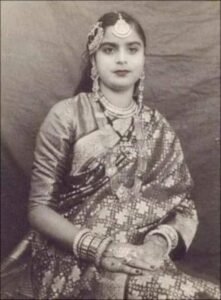
 Lateef Fatima Khan was born on 1 July 1941 in the Tolichowki neighbourhood of Hyderabad into a distinguished professional family. Her father, Iftikhar Ahmed, was a senior government engineer who served as the chief engineer of the port at Mangalore during the 1960s. Lateef Fatima spent part of her early childhood in that coastal city before her family eventually settled in Delhi. She was subsequently educated at Oxford University in England. This distinction placed her among a remarkably small cohort of Muslim women from the Indian subcontinent who pursued higher education abroad in the post-independence decades. While the precise course and college of her Oxford studies have not been independently confirmed by surviving primary documents, her attendance there remains consistently attested across various biographical accounts, including statements attributed directly to her son.
Personal Life and Marriage
Before her marriage, Lateef Fatima had been briefly engaged to the Hyderabad-born Test cricketer Abbas Ali Baig, who himself attended Oxford University in the early 1960s. However, this engagement was dissolved after she met Mir Taj Mohammed Khan, a freedom fighter and Indian National Congress activist originally from Peshawar, who had settled in Delhi following the Partition. According to an account widely attributed to her son, their initial meeting arose from a road accident during which Mir Taj Mohammed rendered timely assistance to Lateef Fatima and her family. Her father, deeply impressed by the man’s conduct, consented to the match in preference to the existing engagement. The couple married in 1959, notwithstanding an age difference of approximately eleven years. They had two children together: a daughter, Shahnaz Lalarukh, and a son, Shah Rukh Khan, born on 2 November 1965 in New Delhi.
Judicial Career and Public Service
Lateef Fatima’s professional career was conducted principally within the Delhi judiciary. She served with distinction as a First-Class Executive Magistrate, a position in which she specialised chiefly in cases involving juvenile delinquency. This work reflected her sustained commitment to the welfare of young and vulnerable citizens. Her son later recalled that she held the record for the longest tenure of any female Executive Magistrate in India. This claim has been corroborated in several published accounts, though it has not been independently verified through official judicial records accessible to researchers. Beyond her courtroom duties, she was a close associate of Prime Minister Indira Gandhi, with whom she collaborated on official and social welfare initiatives. A photograph of the two women together, which widely circulated in later years, testifies to the proximity of that relationship and to the public esteem in which Lateef Fatima was held.
Social Impact and Legacy
In addition to her formal judicial duties, she was an active social worker who engaged extensively with community welfare. Her son described her as “one of the first few Muslim women who had achieved so much.” The sheer breadth of her professional and public life—as a jurist, welfare worker, and confidante of a Prime Minister—fully bears out that characterisation. She served as a formative influence on her son’s intellectual development and personal values, and he credited her with shaping his sense of language, discipline, and social responsibility. He later dedicated his first major industry recognition, a Filmfare Best Male Debut award for Deewana (1992), entirely to her memory, though she had passed away before he achieved mainstream recognition as an actor.
Lateef Fatima Khan died in 1990 from septicaemia arising from a diabetic foot infection at the age of forty-eight. Her death preceded by only a short interval the launch of her son’s film career, a circumstance he has described in numerous interviews as one of his most abiding sorrows. She is buried beside her husband—who had predeceased her in 1981 after a prolonged illness—in New Delhi. The breadth of Lateef Fatima’s professional achievement and the depth of her personal influence warrant recognition independent of the celebrity her surname has subsequently acquired.