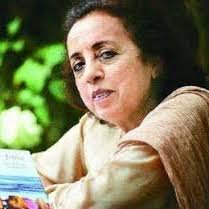
 Anees Jung (b. 15 December 1944, Rourkela, Odisha, India) spent her childhood and adolescence in Hyderabad, where her family belonged to the city’s Muslim aristocracy. Her father, Nawab Hosh Yar Jung, was a distinguished scholar and poet who served as the principal adviser (musahib) to the last Nizam of Hyderabad State. Her mother and brother were also Urdu poets, creating a deeply literary household that shaped her early intellectual development. Following her undergraduate studies at Osmania University, Jung moved to the United States, earning a master’s degree in sociology and American studies from the University of Michigan, Ann Arbour. This cross-cultural academic background seamlessly blended social analysis with documentary inquiry, heavily influencing her upcoming career.
Jung began her professional journey in 1973 as a journalist and editor for Youth Times, a Times of India publication, where she worked until 1980. She later expanded her reach by contributing to international publications like The Christian Science Monitor and the International Herald Tribune. These roles established her global reputation as an insightful commentator on South Asian social affairs. She has spent the majority of her adult life based in New Delhi.
Documenting the Lives of Women
Following her early books, When a Place Becomes a Person (1977) and Flashpoints: Poems in Prose (1981), Jung secured her literary reputation with the landmark publication Unveiling India: A Woman’s Journey (1987). Published by Penguin, the book drew on extensive travel and personal interviews to document the lived experiences of Indian women, particularly those observing purdah. It was widely praised for its empathetic, ethnographic style, transforming oral testimonies into powerful poetic witness and giving an epic quality to its subjects.
Jung continued this vital exploration of interior lives in The Song of India (1990) and Night of the New Moon: Encounters with Muslim Women in India (1993). She expanded her geographic focus with Seven Sisters: Among the Women of South Asia (1994), and took her social inquiries global with Breaking the Silence: Voices of Women from Around the World (1997) and Olives from Jericho: Peace in Winter Gardens (1999), both published under the UNESCO imprint. In her 2003 sequel, Beyond the Courtyard, Jung revisited her original subjects’ households to interview their daughters, discovering that deep-seated structural constraints on women had changed very little despite decades of economic growth.
Focus on Childhood and Enduring Legacy
In 2005, Jung published Lost Spring: Stories of Stolen Childhood, exposing the harsh realities of child labour through moving accounts of the rag-pickers of Seemapuri and the bangle-makers of Firozabad. Now a staple in India’s education system, it features in the NCERT Class XII English textbook, Flamingo, introducing her advocacy to generations of young readers.
Jung’s work is celebrated globally; in 1991, she received a prestigious literary residency fellowship at the MacDowell Colony in New Hampshire. Characterised by close observation and unhurried, evocative prose, her writing exposes structural injustice without offering easy prescriptions. By letting her subjects’ voices carry their own moral weight, Jung has made a monumental, lasting contribution to postcolonial social documentation, women’s rights, and the representation of marginalised children.