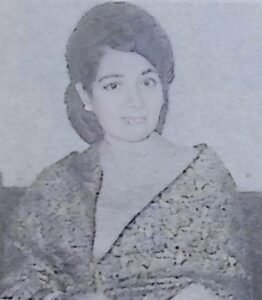
 Syeda Tayyaba Begum, born in Hyderabad on 8 April 1930, is an author, social worker, and educator whose career spans over four decades of literary, academic, and civic engagement. She completed her MA at Women’s College, Osmania University. Her residential address, Khadive Manzil in Banjara Hills, connects her to the extended family network of the Khedive Jung household. This suggests a relationship with Tayeba Begum Khedive Jung (1873–1922), a pioneer educationist and novelist who was among the first Muslim women in India to earn a university degree.
Tayyaba Begum began her teaching career at the N.C.I. Educational Institute, Hyderabad, in 1958. She later taught at Welham Girls’ School in Dehradun (1962) and St Paul’s High School in Hyderabad (1970). Demonstrating the expanding professional opportunities for educated women in post-Independence India, she also worked in the corporate sector. Her roles included serving as an agent and canvasser for the Life Insurance Corporation of India and Kuwait Airways (1970), as well as a canvasser and convenor at Syndicate Bank, Hyderabad (1971).
Social Work and Civic Leadership
From 1975 onward, Tayyaba Begum became a driving force for social and civic development, particularly on the campus of Aligarh Muslim University (AMU). In 1975, she founded a crèche on the AMU campus, and in 1976, she established the Girls’ Section of the Ahmadi School for the Blind, along with functional literacy classes for women and girls. Her civic initiatives included organising an Aligarh cleanliness drive (1976), running children’s programs for the International Year of the Child (1979), and establishing a baby-sitting course and the “Petals” crèche in Hyderabad (1981).
Her leadership extended across numerous cultural and welfare organisations. At AMU, she served as patron of the Drama Club and the Area Development Society, Zohra Bagh, and as president of the classical music society, Sohini. She was the convenor and president of the Aligarh Women’s Welfare Society (1978) and organised a seminar on the status of women in Muslim society at AMU. In Hyderabad, she founded and convened the literary forum Qalam Aur Aawaz (1982), served as vice-president of the South India Urdu Academy’s City Unit (1982), acted as secretary of the Shoba-e-Khawateen section of the Idara-e-Adabiyat-e-Urdu (1983), and was a local executive committee member of the All India Women’s Conference (1982).
Literary Contributions and Legacy
Writing in lucid, accessible Urdu, Tayyaba Begum produced a diverse body of literary and historical work. Her earliest publication, Joohi-ki-Dali (1955), is a collection of children’s stories. She followed this with Abr-e-Neesan (1978), a collection of articles, and Sar-e-Mishgan (1979), a collection of short stories. She also wrote articles and plays for All India Radio, Hyderabad, and staged an Urdu suspense play, Anokha Imtehan, at AMU, which earned commendation from the AMU Drama Club in 1976.
In her later years, she turned to serious historical scholarship regarding the Asaf Jahi dynasty. She authored Meer Osman Ali Khan Aur Unka Ahad (1993), a comprehensive 360-page study of the institutional legacy of the seventh Nizam of Hyderabad. Her companion volume, Meer Usman Ali Khan: Daur-e-Hukumat, Shakhsiyat Aur Khidmaat(1999), offered a more accessible account of the Nizam’s public service for general readers.
Her contributions earned her the International Women’s Year Medal (1975), an AMU Aftab Hall colour for social and literary services (1976), and the Rotary Club Award (1978). Preserved today at the Urdu Arts College, Hyderabad, and on the Rekhta digital platform, her books stand as a vital record of post-Independence social history and active Muslim womanhood.