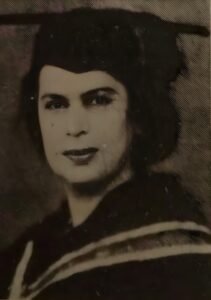
 Syeda Zohra Begum, born in Hyderabad on 12 October 1912, was a prominent Indian educationist and academic administrator. Her educational journey bridged the rich intellectual heritage of the Deccan, the British university tradition, and the reformist ideals of the Aligarh Movement. She pursued her studies across three prestigious institutions: Osmania University in Hyderabad, the University of Leeds in England, and Aligarh Muslim University in Uttar Pradesh. Through these universities, she earned a Bachelor of Arts, a Bachelor of Education, and a Master of Arts. She was later married to Syed Asghar Hussain.
At the very outset of her professional journey in 1935, her exceptional potential was recognised with two prestigious awards. She received the Hydari Gold Medal, a distinction tied to academic excellence and the prominent Hydari family’s contributions to the Hyderabad State, alongside the Miss Pope Principal Women’s College Gold Medal.
Career and Leadership at Osmania University
Zohra Begum’s professional career unfolded over several decades, primarily at Osmania University. Established in 1918 by the seventh Nizam of Hyderabad, Mir Osman Ali Khan, Osmania held the historic position of being the first Indian university to adopt Urdu as its medium of instruction. Zohra Begum began her career there as Headmistress of the Teachers’ Training School from 1936 to 1938. She then served as a Reader at the College of Education (1939–40) and subsequently as a Lecturer in the Faculty of Education (1941–55).
In 1956, she reached a milestone of exceptional distinction for a woman academic of her era when she was appointed College Principal and Dean of the Faculty of Education. In this capacity, she directed teacher training and shaped high-level educational policy. Her leadership and institutional influence were cemented by her long-standing concurrent membership on both the Academic Council and the Senate of Osmania University from 1956 to 1972. During this exact same sixteen-year window, she also provided continuous service on the university’s Board of Examination, underscoring the deep trust the institution placed in her governance.
Regional Influence and Civic Affiliations
Beyond her home institution, Zohra Begum played an important role in standardising teacher-education curricula across southern India during critical post-independence decades. She served as Chairman of the Studies Committees in Education at multiple major institutions, including Kerala University, Mysore University, Andhra University, and Annamalai University. Furthermore, she served on the Board of Revenue and on the Programme Advisory Committee of the State Council of Education Research and Training in Hyderabad, anchoring her at the crossroads of academic policy and public administration.
Her intellectual and social commitments were equally diverse. While studying in England, she was a member of the English Poetry Society of the United Kingdom from 1939 to 1943. Locally, she actively participated in the Women’s Educational Conference and the Lady Hydari Club. Founded in 1929, the Lady Hydari Club was a premier elite institution that served as a vital hub for social, cultural, and philanthropic engagement among educated women within the Nizam’s dominions. Through her multifaceted legacy as a Dean, Senate member, and regional curricular authority, Syeda Zohra Begum contributed decisively to the institutionalisation of modern higher-education governance in peninsular India.