
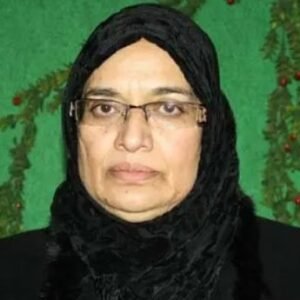
 Gousia Jeelani (b. c. 1952–1953, Nawakadal, Srinagar, Jammu and Kashmir)— also documented as Gous-ul-Nissa Jeelani — is a premier legal figure in modern Jammu and Kashmir, widely recognised as the first woman appointed to the state’s subordinate judiciary. Born in Nawakadal, Srinagar, she grew up in a family that supported her education but hesitated at the prospect of a daughter practising law. Gousia initially envisioned a career in medicine, which her mother encouraged. However, her ambitions shifted decisively in her school library while reading a newspaper profile of India’s first female judge. Deeply moved, she resolved before finishing the article to join the judiciary.
After earning her undergraduate degree in 1973, Gousia applied for the LLB program at Aligarh Muslim University (AMU) without informing her family. Her hardest step was persuading them to let her study outside the state. Upon graduation, she returned to Srinagar to practice at the Bar. Entering an overwhelmingly male profession brought intense familial pressure and public censure; a neighbour once remarked that the Jeelanis must have lost everything if they were sending their daughters to mix with criminals. This comment vividly illustrated the social resistance she encountered early on.
Judicial Career and Challenges in the Valley
After two years in legal practice, Gousia sat the Public Service Commission examination and, in February 1979, was appointed a Munsif — a first-tier subordinate civil judge — at the age of twenty-six. Multiple published accounts consistently identify her as the first woman to hold this office in Jammu and Kashmir, a distinction that has not been contradicted by independent sources. Her services were regularised in 1982 following a further PSC examination, and she was subsequently promoted to Sub-Judge and appointed Chief Judicial Magistrate, Srinagar.
That posting coincided with the peak years of the armed insurgency in the Kashmir Valley. On one occasion, a man entered her chamber demanding that she commit him to gaol; when she refused, he struck her repeatedly in the face with a broken glass. She was hospitalised and required multiple facial sutures. On recovering, Gousia firmly declined the offer of an alternative, safer posting, stating simply that she was not a coward.
Later Service and Institutional Legacy
Over a career spanning approximately three decades, Gousia served as Principal District and Sessions Judge across four districts — Srinagar, Anantnag, Budgam, and Baramulla — and also sat as Special Judge in the Anti-Corruption Court. At the time of her retirement, she had attained the highest judicial rank available to subordinate-court officers in the state, a trajectory charted despite sustained institutional and social resistance.
Following retirement, Gousia was appointed by the Governor of Jammu and Kashmir, N. N. Vohra, as the second Vigilance Commissioner of the State Vigilance Commission (SVC) in August 2013. Gousia has indicated her intention to write a memoir of her years on the bench, observing that, as a female judge, she was repeatedly obliged to prove herself anew. No such memoir had appeared at the time of writing, leaving her landmark career to be remembered through her historic contributions to the region’s judiciary.