
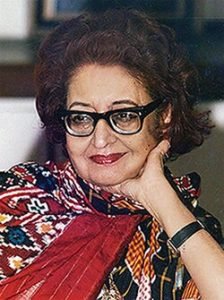
 Qurratulain Hyder (1927-2007) was a monumental figure in 20th-century Urdu literature, celebrated as a novelist, scholar, and translator who fundamentally reshaped the landscape of modern fiction in South Asia. Born in Aligarh, India, in 1927 to a family of distinguished writers, she was immersed in a literary environment from her earliest days. This upbringing, coupled with her formal education in English literature, provided a rich foundation for her trailblazing career. After the partition of India, she briefly moved to Pakistan but returned to India, where she worked as a journalist and academic, producing a remarkable body of literary work throughout her career.
Hyder’s most significant contribution was elevating the novel to a serious art form in Urdu, a language whose literary tradition had long been dominated by poetry. She was a pioneer of experimental styles, most notably the “stream of consciousness” technique, which she used to delve into the inner lives of her characters. Her narratives masterfully weave together personal stories with grand historical events, exploring themes of cultural identity, the trauma of Partition, and social change. She is particularly noted for creating strong, capable female characters who defy stereotypes, making her an important, if not overtly activist, feminist icon.
Her magnum opus, Aag ka Darya (River of Fire), published in 1959, is regarded as a landmark in South Asian literature. With a breathtaking scope that spans over two thousand years of Indian history, the novel laments the division of a shared, syncretic culture caused by Partition. Its critique of the two-nation theory was highly controversial, particularly in Pakistan, and the backlash was a significant factor in her decision to leave the country permanently for India. Despite the controversy, the novel’s literary innovation and profound vision cemented its place as a masterpiece, often drawing comparisons to the works of Gabriel García Márquez.
Fluent in both Urdu and English, Hyder was a crucial cultural bridge. She translated many of her own works into English, bringing them to a global audience, and also translated world literature into Urdu. Her influence is profound and lasting, having paved the way for generations of novelists, including internationally acclaimed authors like Salman Rushdie.
For her immense contributions, Qurratulain Hyder received India’s highest literary honours, including the Sahitya Akademi Award, the prestigious Jnanpith Award in 1989, and the Padma Bhushan in 2005. She passed away in 2007, leaving behind a rich and enduring legacy as one of the most important writers of her time.