
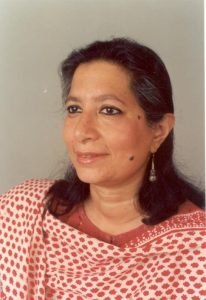
 Shama Futehally (1952-2004), shown as Shama Jawid Chowdhury in her genealogical profile, was a distinguished Indian novelist, translator, and educator whose work is celebrated for its spare elegance and deep moral intelligence. Born in Bombay into a family of immense intellectual and cultural stature, she was raised in a family steeped in India’s natural and secular heritage. Her father, Zafar Futehally, was a renowned naturalist and recipient of the Padma Shri, while her mother, Laeeq Futehally, was a writer and the niece of the legendary ornithologist Salim Ali. This lineage—descended from Badruddin Tyabji, the third president of the Indian National Congress—informed Shama’s lifelong commitment to secular values and her acute sensitivity to the social fractures of modern India.
Futehally’s academic journey took her from the University of Bombay to the University of Leeds. She dedicated over three decades to teaching English and cultural history in Bombay and Ahmedabad before moving to Delhi. There, she served as a professor of Western Drama at the National School of Drama (NSD). Throughout her career, she balanced her pedagogical roles with a disciplined literary output, exploring the anxieties of minority identity and the quiet erosion of the Nehruvian secular ethos with a precision that garnered lasting critical acclaim.
Literary Contributions and Legacy
Futehally’s fiction is characterised by a “pared-down” prose that carries immense emotional weight. Her debut novel, Tara Lane (1993), examines the fragility of a cultured Bombay family as they face labour unrest and moral compromise. Her second novel, Reaching Bombay Central (2002), uses a train journey to filter the personal and political anxieties of a Muslim woman navigating a changing India. Posthumously, her short stories were collected in Frontiers (2006), featuring a fictionalised account of the Uphaar Cinema tragedy—a project she was still developing at the time of her death.
Beyond fiction, Futehally was a gifted translator and essayist. Her rendering of Meerabai’s devotional poetry, In the Dark of the Heart (1994), is praised for capturing the spiritual intensity of the original verse. She also translated Urdu ghazals and wrote extensively on the politics of language and the challenges of translation, work later compiled in The Right Words (2006). An avid birdwatcher like her father, she often mirrored the psychological landscapes of her characters in her attentiveness to the natural world. Shama Futehally died of cancer on December 3, 2004, leaving behind a legacy as a writer who wrote with “the right words” for a domestic audience, focusing on the intersection of individual conscience and national identity.