
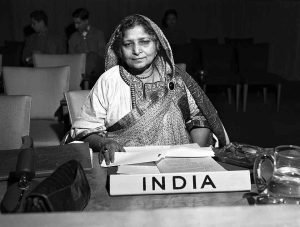
 Shareefa Hamid Ali (c. 1883–1971), sometimes spelt Sharifa Hamid Ali, also known as Begum Hamid Ali, was a towering figure in the Indian nationalist movement and a global advocate for women’s rights. Born in Baroda into the illustrious Tyabji family, she was raised in a progressive environment that championed education and social reform. Her father, Abbas Tyabji, was a Chief Justice and a close associate of Mahatma Gandhi, while her mother, Amina, was among the first Muslim women to publicly abandon purdah. Fluent in six languages and deeply cultured, Shareefa married her cousin, Hamid Ali, an Indian Civil Service officer, and settled in the Bombay Presidency, where she began her life’s work of grassroots and institutional reform.
National Reform and the AIWC
Shareefa’s political awakening began at the 1907 Indian National Congress session, fueling her commitment to the Swadeshi movement and the upliftment of marginalised communities. She spent years establishing nursing centres and literacy classes in rural villages, but her most significant domestic impact came through the All-India Women’s Conference (AIWC). Rising through its ranks to become President in 1935, she transformed the organisation into a powerhouse for legislative change.
A fierce opponent of child marriage, Shareefa mobilised Muslim women to support the Sarda Act of 1929, arguing that women should not marry until they were at least eighteen and sufficiently educated. She viewed purdah as a symbol of gendered oppression and social division, and she was a vocal proponent of a secular civil code. Drawing inspiration from modernisation efforts in Turkey and Iraq, she navigated complex communal tensions to advocate for a legal framework that treated all women as equal citizens regardless of faith.
International Advocacy and the United Nations
Shareefa’s vision extended far beyond the Indian subcontinent. In 1933, she testified before the Joint Select Committee in London, arguing for universal adult franchise and opposing separate electorates, which she believed would stall progress on family law reform. Alongside Rajkumari Amrit Kaur, she petitioned the League of Nations in Geneva and represented India at international women’s congresses in Istanbul and Czechoslovakia.
The pinnacle of her career came in 1947, when she was appointed one of the 15 founding members of the United Nations Commission on the Status of Women (CSW). At Lake Success, New York, she helped draft the Commission’s guiding principles, which sought to eliminate discrimination in both statutory and customary law globally. Her contributions were also vital in securing gender-inclusive language in the Universal Declaration of Human Rights, ensuring that “human rights” explicitly encompassed women’s rights.
Beyond her international diplomatic roles, Shareefa served on the National Planning Commission and the Hindustan Textbook Committee, ensuring that education and gender equity remained central to India’s developmental blueprint. Although she passed away in Mumbai in 1971 and remains somewhat underrepresented in mainstream history, her legacy is profound. She bridged the gap between anti-colonial activism and the creation of modern international human rights frameworks, proving that the struggle for Indian independence was inextricably linked to the global fight for gender equality.