
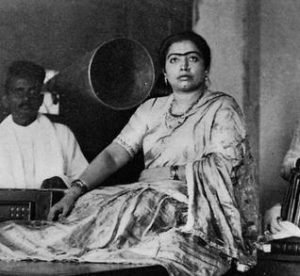
 Gauhar Jaan (1873–1930) was a pioneering Hindustani classical vocalist and Kathak dancer who became India’s first recording superstar. Born Eileen Angelina Yeoward in Azamgarh to an Armenian Christian father and a mother of mixed British and Indian parentage, she experienced a dramatic shift in her life following her parents’ separation in 1879. She and her mother, Victoria, moved to Banaras and converted to Islam, adopting the names Gauhar Jaan and Malka Jaan, respectively. Under the patronage of a nobleman, Malka Jaan became an accomplished singer and poet, eventually moving the family to Calcutta. There, Gauhar received rigorous training from eminent masters, including Kale Khan of Patiala and the Kathak maestro Brindadin Maharaj. This diverse education allowed her to master a vast repertoire, ranging from khayal and thumri to ghazal and bhajan, and to often compose her own verses under the pen name “Hamdam.”
She made her public debut at the age of fourteen at the court of the Maharaja of Darbhanga. By the 1890s, she was celebrated as the “first dancing girl of Calcutta,” performing at major venues and princely courts across India. A career highlight occurred in 1911 when she performed a duet for King George V at the Delhi Durbar. Her fame was so immense that her image appeared on postcards and international matchbox labels, reflecting her status as a cultural icon who bridged the gap between the elite salons of the nobility and the emerging public sphere.
The Gramophone Revolution and Legacy
Gauhar Jaan’s most significant historical contribution was her early embrace of sound technology. In November 1902, she became the first Indian artist to record commercially for the Gramophone Company. In a makeshift studio in Calcutta, she recorded a khayal in Raag Jogiya, famously ending with the declaration, “My name is Gauhar Jaan.” This phrase became her signature and a hallmark of the burgeoning Indian recording industry. Between 1902 and 1920, she recorded over 600 songs in more than ten languages. Crucially, she mastered the art of compressing elaborate, hours-long ragas into the three-minute limit of a 78-rpm disc, a feat of musical adaptation that shaped the future of recorded Indian music.
Despite her professional success and flamboyant lifestyle, her later years were shadowed by personal and financial struggle. A bitter legal battle with her secretary and husband, Saiyad Gulam Abbas, over embezzled funds drained much of her fortune. In 1928, she accepted a position as a Palace Musician for the Maharaja of Mysore, a role she held until her death in 1930. Today, her legacy is preserved through the restoration of her original recordings by Saregama India and her portrayal in modern literature and theatre. By demonstrating that classical music could retain its soul within the constraints of technology, Gauhar Jaan democratised Indian art, ensuring it reached audiences far beyond the royal courts.