
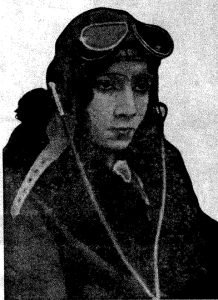
 Imtiazi Begam, also widely known by her married name Begum Hijab Imtiaz Ali, was a remarkable and trailblazing figure in the 1930s who shattered conventions in both aviation and literature. A true pioneer, she challenged the restrictive societal norms of her time, becoming a powerful symbol of women’s empowerment and a source of inspiration for generations to come.
Her most celebrated and historic achievement came in 1939, when she earned her pilot’s license, becoming the first Muslim woman in the entire British Empire to do so. This was an extraordinary feat at a time when women, particularly from conservative backgrounds, were primarily confined to the domestic sphere. Aviation was considered an exclusively male domain, and her pursuit of flying was a direct challenge to this notion. With the encouragement of her family, who recognised her passion and talent, she ventured into this field, demonstrating not only her personal courage but also the immense capabilities of women to excel in any arena they choose. Her achievement resonated deeply with the broader movement for social progress in India, proving that women could and should participate in all aspects of modern life.
In addition to her accomplishments in the sky, Imtiazi Begam was a celebrated Urdu writer with a distinct and powerful literary voice. Her talent was evident from a very young age. When she was just 12 years old, she wrote the short story “Meri na-kaam Mohabbat” (“My failed love”), which has since been hailed as a classic of Urdu romantic literature. This work showcased her profound intellectual and emotional maturity, as well as her skill in expressing complex themes of love, loss, and societal expectations from a female perspective. Her writing provided a valuable glimpse into the inner world of young women navigating the complexities of their time, further challenging traditional narratives by giving voice to female experiences.
The dual legacy of Imtiazi Begam is one of courage and creativity. As a pilot, she broke physical and social barriers, paving the way for other women to pursue careers in aviation and other traditionally male-dominated professions. As a writer, she delved into the depths of human emotion and gave voice to perspectives that were often unheard. In both her life and her art, she exemplified the spirit of the modern Indian woman, pushing for freedom, self-expression, and a more equitable world.