
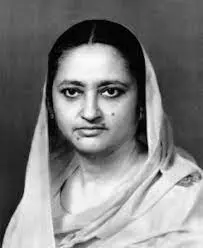
 Saeeda Khurshid (1927–2015) was a pivotal, yet understated, figure in 20th-century Indian social reform, recognised for architecting a unique “middle ground” for empowering Muslim women. As the founder of the Muslim Women’s Forum (MWF), she championed a strategy of dialogue and internal consensus-building, particularly with religious leadership (the Ulema), rather than engaging in overt confrontation. Her approach was to seek change from within the community’s own intellectual and spiritual traditions, arguing that sustainable progress required reclaiming authority from within Islamic heritage itself. This methodology of fostering dialogue—bringing “Ulema and Women on one stage”—was her primary pathbreaking contribution, offering a new paradigm for reform that moved beyond the typical binary of secular legal challenges and conservative religious opposition.
Her strategic, non-confrontational approach was deeply shaped by her remarkable lineage. As the daughter of Dr. Zakir Husain, India’s third President, and the wife of Khurshed Alam Khan, a Union Minister and Governor, she had an insider’s understanding of the Indian state and the mechanics of power. This environment, steeped in the Nehruvian ideals of public service and educational advancement, provided the intellectual foundation for her work. Her family, including her son, Salman Khurshid, who became a prominent Union Minister, continued this tradition of service. This upbringing gave her a unique vantage point from which to build bridges between tradition and modernity, a theme that would define her activism.
Long before her public role, Saeeda Khurshid demonstrated her progressive ideals through personal acts of defiance. In 1947, at the dawn of India’s independence, she made the symbolic decision to abandon the burqa, aligning herself with the modern, nation-building project. This act of symbolic liberation was coupled with a determined pursuit of intellectual empowerment. She continued her studies as a private student, travelling between Delhi and Aligarh for examinations, eventually becoming a gold medalist. This synthesis of rejecting traditional constraints while embracing rigorous education formed the philosophical core of her later work, which focused on both challenging stereotypes and promoting tangible empowerment through knowledge.
Though described as a private person, Khurshid engaged selectively but impactfully in the public sphere. She campaigned for the Congress party and, most significantly, authored a book in 1976 about her father, Zakir Sahib ki Kahani Unki Beti ki Zubaani. This memoir served as a blueprint for her later activism, articulating the values of humility, duty, tolerance, and compassion that she would institutionalise through the Muslim Women’s Forum.
Founded in 2000, the MWF became the primary vehicle for her vision. Grounding its advocacy in a compassionate, gender-sensitive interpretation of the Quran, the Forum challenged patriarchal norms from within the faith. A key initiative was the “Pathbreakers: The Twentieth Century Muslim Women of India” exhibition, a collaboration with UN Women designed to dismantle the stereotype of the oppressed Muslim woman by showcasing historical female role models who were instrumental in shaping modern India.