
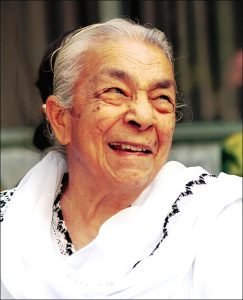
 Zohra Sehgal (1912–2014) was a foundational figure in South Asian performing arts, with a career spanning eight decades across dance, theatre, and cinema. Born Sahibzadi Zohra Mumtazullah Khan Begum into a liberal landed family in Rampur, she was raised by her maternal uncle following her mother’s early death. Her sister, Uzra Butt, also became a renowned actress. Breaking traditional norms, Sehgal travelled by car from Lahore through the Middle East to Europe after graduating from Queen Mary College. In Dresden, Germany, she became the first Indian to graduate from Mary Wigman’s School of Modern Dance, specialising in experimental modern dance.
In 1935, she joined Uday Shankar’s prestigious dance troupe as a principal dancer, touring Japan, Europe, and the United States. She later joined the faculty of the Uday Shankar India Cultural Centre in Almora, where she met her husband, Kameshwar Sehgal. Despite the political turmoil of the 1942 Quit India Movement—which led to the arrest of their intended wedding guest, Jawaharlal Nehru—the couple married and established the Zohresh Dance Institute in Lahore. Following the communal unrest of 1945, they relocated to Bombay.
From the Stage of IPTA to Global Screens
In Bombay, Sehgal’s career evolved as she joined Prithviraj Kapoor’s Prithvi Theatre and the Indian People’s Theatre Association (IPTA). She made her film debut in the social-realist classic Dharti Ke Lal (1946) and appeared in Neecha Nagar (1946), which won the Grand Prix at the inaugural Cannes Film Festival. She also contributed her expertise as a choreographer for Raj Kapoor’s Awaara (1951). After her husband’s passing in 1959, she briefly led the Natya Academy in Delhi before moving to London in 1962 on a drama scholarship.
Her British career began with financial struggles but eventually flourished. She appeared in iconic series such as Doctor Who (1965) and The Jewel in the Crown (1984), and in films such as My Beautiful Laundrette (1985) and Bhaji on the Beach (1992). These roles made her one of the first South Asian performers to achieve sustained mainstream visibility in the UK. Returning to India in 1987, she experienced a remarkable late-career resurgence in Hindi cinema. Audiences loved her spirited performances in Dil Se (1998), Hum Dil De Chuke Sanam (1999), and Cheeni Kum (2007). Notably, at age ninety, she played the lead in Chalo Ishq Ladaaye (2002).
A Lasting Legacy of Excellence
Sehgal’s personal and professional life often mirrored the history of the subcontinent. In 1993, she performed in the play Ek Thi Nani with her sister Uzra; the story of sisters separated by Partition reflected their own reality after Uzra moved to Pakistan. Her life was documented in her memoir, Close-Up (2010), and in biographies by her daughter, Kiran Segal, and the author Ritu Menon.
Recognised as a national treasure, she received India’s highest honours, including the Padma Shri (1998), the Padma Bhushan (2002), and the Padma Vibhushan (2010). She was also a Fellow of the Sangeet Natak Akademi and was named “Laadli of the Century” in 2008. Zohra Sehgal passed away in 2014 at the age of 102. In 2020, Google honoured her with a Doodle, cementing her status as one of India’s first truly international female artists who bridged the gap between traditional heritage and modern performance.