
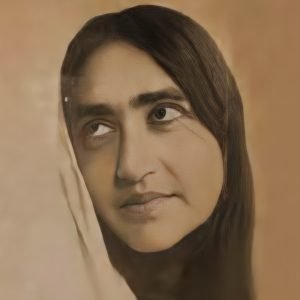
 Wajida Tabassum (1935-2011) was a distinguished and controversial Indian Urdu-language writer, celebrated for her bold and unapologetic exploration of female sexuality, desire, and the decadent, often exploitative, lives of the Hyderabadi aristocracy. Often compared to literary giants like Ismat Chughtai and Saadat Hasan Manto for her rebellious and taboo-breaking narratives, Tabassum carved a unique and enduring niche in Urdu literature, leaving behind a legacy that continues to provoke and inspire.
Born on March 16, 1935, in Amravati, Maharashtra, Wajida Tabassum hailed from an aristocratic Hyderabadi family that had lost its wealth. Her early life was marked by financial hardship, a stark contrast to the noble lineage she belonged to. Orphaned at a young age, she developed a passion for reading and writing, pursuing her education with determination. She graduated with a degree in Urdu from Osmania University, a significant achievement that laid the foundation for her literary career.
After her graduation, she moved to Hyderabad. She later married her cousin, Ashfaq Ahmed, a writer who worked for the Indian Railways. He proved to be a supportive partner, recognising her talent and later establishing his own press, Dastawaiz Publications, in Mumbai, primarily to publish her works. The couple had five children and settled in Mumbai, where Tabassum spent the majority of her life until her passing on December 7, 2011.
Notable Contributions to Urdu Literature
Wajida Tabassum began her writing career in the 1940s, initially publishing her stories in various magazines. Her work immediately stood out for its candidness and focus on the inner lives of women trapped within the patriarchal and feudal structures of old Hyderabad.
Her most significant contribution was her fearless depiction of themes considered scandalous for her time:
-
Critique of the Aristocracy: Tabassum’s stories systematically dismantled the romanticised image of the Hyderabadi nawabs. She exposed the hypocrisy, decay, and moral corruption hidden behind the opulent facades of their grand havelis.
-
Female Sexuality and Desire: Unlike many of her contemporaries, Tabassum placed female desire at the centre of her narratives. She wrote explicitly about women’s sexual experiences, frustrations, and fantasies, giving voice to a subject long suppressed by societal norms.
-
Social Exploitation: A recurring theme in her work is the exploitation of the lower classes, particularly young women who served the wealthy as maids, concubines, and disposable objects of pleasure.
Her writing style was direct, evocative, and deeply realistic. She did not shy away from using sensual and even erotic language to convey the psychological and emotional landscapes of her characters, which led to both immense popularity and severe criticism.
Major Publications
Wajida Tabassum was a prolific writer, authoring a total of 27 books. Her stories were commercially successful, often reprinted multiple times. Some of her most notable publications include:
-
Utran (Cast-Offs): This is arguably her most famous and controversial work. The collection’s title story is a searing tale of a young servant girl who is systematically used to “break in” new clothes, jewellery, and eventually the bed, for her master, the nawab, before being discarded and “passed down” to a servant. The story caused a massive uproar, leading to public protests and the burning of her effigies. It was later adapted into a television serial and a 2005 Bollywood film.
-
Shahr-e-Mamnu (The Forbidden City): A collection of stories that delves into the hidden lives and forbidden desires within the walls of aristocratic homes.
-
Teh Khana (The Cellar): This work also explores themes of confinement and hidden secrets within feudal families.
-
Zar, Zan, Zamin (Wealth, Woman, Land): The title itself encapsulates the three primary objects of obsession and conflict in the feudal world she depicted.
-
Nath Ka Bojh (The Burden of the Nose Ring): A collection that further explores the burdens and rituals imposed upon women.
-
Kaise Samjhaoon (How Do I Explain): A collection of stories reflecting on the complexities of human relationships and unspoken desires.
In recent years, several of her stories have been translated into English, bringing her powerful voice to a new, global audience.