
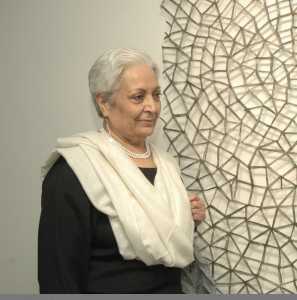
 Zarina Hashmi (1937-2020) was a celebrated Indian-American artist whose work powerfully explored themes of home, memory, displacement, and belonging. Known professionally simply as Zarina, she developed a distinctive minimalist aesthetic, combining geometric abstraction with deeply personal narratives that resonated with universal experiences of migration and identity.
Born in Aligarh, India, Zarina’s upbringing in a scholarly Muslim family and her Bachelor of Science degree in mathematics profoundly shaped her artistic vision, instilling a lifelong appreciation for geometry and structural purity. An early fascination with architecture was solidified by a childhood aeroplane ride, where an aerial view of her hometown sparked an enduring interest in maps and topology. Her marriage to a diplomat in 1958 launched a peripatetic life, which became an extended period of artistic education. She immersed herself in diverse printmaking techniques across the globe, studying intaglio in Paris at the renowned Atelier 17 and traditional woodblock printing in Tokyo.
Zarina was primarily a printmaker, favouring a tactile approach that involved carving and gouging surfaces. She worked with intaglio, woodcuts, and cast paper, often creating series of works accompanied by Urdu text, her mother tongue. After her husband’s unexpected death, she made New York City her permanent home in 1976 and became a vital contributor to the city’s feminist art movement. She served as a board member of the New York Feminist Art Institute, taught papermaking workshops, and co-curated the landmark 1980 exhibition, “Dialectics of Isolation: An Exhibition of Third World Women Artists of the United States.”
Her most iconic work, the 1999 portfolio Home is a Foreign Place, consists of 36 woodcuts. Each print pairs a minimalist, symbolic image—such as a floor plan or a map—with an Urdu word, collectively forming a poignant poem about the elusive concept of home. Another deeply personal series, Letters from Home (2004), incorporated unsent letters from her sister, overlaying the handwritten script with architectural diagrams to create a meditation on family ties, distance, and grief. These works exemplify her ability to transform personal experience into universally resonant art.
Widespread recognition arrived later in her life, highlighted by her selection to represent India at the 2011 Venice Biennale and a major retrospective, Zarina: Paper Like Skin, which toured top American museums in 2012-2013. Her work is held in the permanent collections of institutions like the MoMA, the Guggenheim, and the Tate Modern. Zarina’s enduring legacy lies in her unique visual language, which blended Western modernism with Islamic geometric traditions. She demonstrated how personal history—rooted in the trauma of Partition and a life of exile—could be distilled into a universal exploration of identity and the search for a place to call home.