
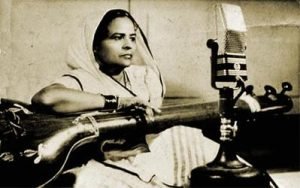
 Rasoolan Bai (1902-1974) was a towering figure in twentieth-century Hindustani classical music and a definitive exponent of the Benaras gharana. Born in Kachhwa Bazaar, Mirzapur, she inherited her musical foundation from her mother, Adalat Bai. Recognising her prodigious talent, her family placed her under the tutelage of Ustad Shammu Khan, a noted Khayal and Kathak specialist. Her education continued under sarangi masters Ashiq Khan and Ustad Najju Khan, whose instrumental influence refined her melodic phrasing. Through this traditional guru-shishya parampara, she mastered the Purab Ang (eastern style) of thumri, as well as semi-classical forms like tappa and dadra, and the seasonal folk traditions of Uttar Pradesh, such as kajri and chaiti.
In the 1920s, Rasoolan Bai began her professional journey in the princely courts, gaining fame after a landmark debut at the Dhananjaygarh court. By the mid-twentieth century, she was the acknowledged doyenne of her style, performing alongside legends like Siddheshwari Devi and Begum Akhtar. She became a staple of All India Radio and Doordarshan, broadcasting regularly until 1972. Beyond her vocal prowess, she is credited with popularising the now-standard practice of singers covering one ear during performances to monitor their pitch.
Musical Artistry and Legacy
Rasoolan’s artistry was defined by the bol banao technique, which prioritises the emotional nuance of lyrics over rapid technical displays. Her interpretations of Raag Bhairavi remain legendary for their restrained intensity and themes of devotional surrender. Her 1930s gramophone recordings provide a vital archive of pre-Independence music. Notably, her rendition of “Phool Gendwa Na Maaro” became the focus of Saba Dewan’s 2009 documentary, The Other Song, which examined how thumri lyrics were “sanitised” to meet the moral codes of post-colonial India.
As one of the last great practitioners of the tawaif (courtesan) tradition, Rasoolan Bai’s life reflected the shifting social status of female performers. In 1948, she ceased performing mujra and married a silk dealer named Suleman. This transition was partly influenced by All India Radio’s requirement for female artists to provide marriage certificates as proof of “respectability.” Despite these social pressures, her talent was officially recognised in 1957 when she received the Sangeet Natak Akademi Award, India’s highest honour for performing artists.
However, her later years were defined by profound hardship. Following the migration of her husband and son to Pakistan, she moved to Ahmedabad. During the 1969 communal riots, her home was burned down—a trauma that effectively silenced her singing voice and was later memorialised by the poet Agha Shahid Ali. She spent her final years in Allahabad, living in poverty and running a small tea stall near the radio station where she had once been a star. She passed away on December 15, 1974. Today, her legacy survives through her recordings and the work of her disciples, such as the renowned vocalist Naina Devi. Her life remains a poignant symbol of the artistic heights and social vulnerabilities of women in Indian classical music.