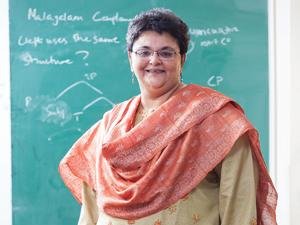
 Professor Ayesha Kidwai, a distinguished theoretical linguist at Jawaharlal Nehru University (JNU), was awarded the Infosys Prize in Humanities – Linguistics in 2013 for her exceptional contributions to the field. The prize celebrated her groundbreaking research on the syntactic structures of Hindi-Urdu and other South Asian languages, which has significantly advanced linguistic theory by connecting regional language phenomena with universal frameworks.
Kidwai’s scholarly work is anchored in Noam Chomsky’s theory of Universal Grammar, which she applies to unravel the principles governing India’s vast linguistic diversity. Her most significant contributions relate to “scrambling,” the phenomenon of free word order found in languages like Hindi-Urdu. Challenging conventional views, she proposed a novel theory that this flexible word order is not random but is systematically driven by discourse and informational focus. This was articulated in her landmark 2000 book, XP-adjunction in Universal Grammar: Scrambling and Binding in Hindi-Urdu, where she argued that scrambling is a uniform syntactic operation. Her research extends beyond Hindi-Urdu to include languages like Bengali, Malayalam, and Santali, showcasing a comprehensive approach to the syntax of South Asian languages.
Beyond her core linguistic research, Professor Kidwai is an acclaimed translator. She has brought the important works of her grandmother, the writer and social activist Anis Kidwai, to an English-speaking audience. Her translation of the Urdu Partition memoir Azaadi Ki Chaon Mein, as In Freedom’s Shade, received widespread critical acclaim and a nomination for a major book award. This work highlights her deep engagement with the social and political history of the subcontinent.
Professor Kidwai’s career is also defined by her unwavering commitment to social justice and academic freedom. In 1999, she was a pioneering force in establishing the Gender Sensitisation Committee Against Sexual Harassment (GSCASH) at JNU, creating an institutional template that was later adopted by universities across India. As President of the JNU Teachers’ Association (JNUTA) in 2016, she was a prominent advocate for the university’s autonomy and defended academic freedom during a period of intense political turmoil.
Her work has garnered significant international recognition, including her election as an International Fellow of the British Academy in 2023. The Infosys Prize jury commended her not only for her theoretical brilliance but also for her leadership in mentoring young scholars and raising the profile of linguistics in India. By linking detailed analysis of Indian languages to global theory, Professor Kidwai has consistently highlighted the cultural and political importance of India’s linguistic heritage. She stands as a unique intellectual figure who masterfully combines rigorous scholarship with social activism and cultural preservation.