
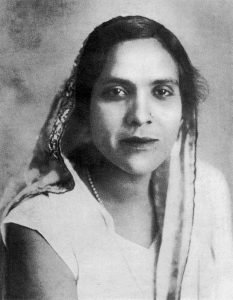
 Jaddanbai Hussain was a multifaceted artist and a pioneering figure in early Indian cinema. She excelled as a singer, music composer, dancer, actress, filmmaker, and producer, breaking significant barriers to become one of the first female music directors in Indian cinema. Her legacy is also deeply intertwined with her family, as she was the mother of legendary actress Nargis and the grandmother of Bollywood stars Sanjay Dutt and Priya Dutt.
Born in Benares (now Varanasi) to a renowned courtesan, Jaddanbai’s early life was marked by tragedy and resilience. Raised within the rich tradition of tawaif culture, she was part of a community that played a crucial role in preserving and advancing classical Indian music and dance. Though initially lacking formal training, she became a student of several distinguished ustads after the death of her first mentor, Shrimant Ganpat Rao. She trained under notable figures like Ustad Moinuddin Khan and Barkat Ali Khan, the younger brother of the legendary Bade Ghulam Ali Khan.
Jaddanbai’s musical talent flourished, making her a celebrated recording artist with the Columbia Gramophone Company. Her voice, featured in popular ghazals and songs, was broadcast on radio stations nationwide. She was regularly invited to perform in mehfils (musical gatherings) by the rulers of prominent princely states, cementing her reputation as a highly sought-after performer and a custodian of cultural refinement.
Transition to Cinema and Filmmaking
Jaddanbai’s entry into cinema began in 1933 with her acting debut in Raja Gopichand. Driven by an entrepreneurial spirit, she established her own production company, Sangeet Films, in 1936. This made her one of the pioneering women producers in Indian cinema, following in the footsteps of trailblazers like Fatima Begum.
Under her banner, Jaddanbai took on multiple roles, serving as a producer, director, writer, actress, and music composer for several films. Her debut production, Talash-e-Haq (1935), was a family affair where she acted and introduced her six-year-old daughter, Fatima (later known as Nargis), as a child artist. She also composed music and performed songs in her films, including Hriday Manthan (1936) and Madam Fashion (1936). Her narratives often featured socially marginalised women, reflecting her own experiences as a former tawaif and challenging societal perceptions.
Personal Life and Legacy
Jaddanbai’s personal life was as unconventional as her career. She was married three times, and each of her husbands converted to Islam upon marriage. These relationships resulted in her three children: Akhtar Hussain, Anwar Hussain, and the legendary actress Nargis. Despite her and her husbands’ conversions, Jaddanbai maintained aspects of Hindu traditions, reflecting the fluid and complex religious identities of her time. As the primary breadwinner, she embodied an independent spirit that would later influence her daughter Nargis.
Her contributions to Indian cinema were groundbreaking. As one of the first female music composers and a successful producer, she demonstrated that women could excel in all aspects of film production. When financial difficulties led to the closure of her production company, she made the difficult decision to introduce her 14-year-old daughter Nargis to the film industry, a move that launched one of Indian cinema’s most celebrated careers. Jaddanbai’s life story is a testament to the resilience, artistic excellence, and entrepreneurial spirit of women who helped shape early Indian cinema. Her influence continues to resonate through her family’s legacy and the enduring impact of tawaif culture on the film industry.