
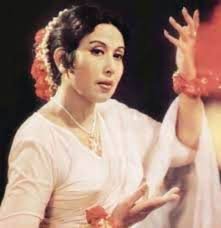
 Iqbal Bano (1935–2009) was an iconic classical and ghazal singer, revered as the Malika-e-Ghazal (Queen of Ghazal) and remembered for her powerful voice and courageous spirit. Born in Delhi, India, during the British Raj, she became one of the region’s most prominent cultural figures, leaving an indelible mark on subcontinental music. Her career spanned decades, marked by a unique blend of classical rigour and emotional depth, culminating in her iconic, politically charged renditions of poet Faiz Ahmed Faiz.
Born into a family of landowners from Rohtak, Iqbal Bano showed an early aptitude for music. Her formal training began under the tutelage of Ustad Chand Khan of the famed Delhi Gharana, a legendary master of classical music. She was trained in the semi-classical forms of thumri and dadra, which would later become hallmarks of her unique style. After the Partition of India, she migrated to Pakistan in 1952, settling in Lahore with her husband, a notable landlord.
Her professional career took off with her performances for Radio Pakistan, where her talent quickly garnered attention. She transitioned from being a local favourite to a national star, known for her ability to sing a variety of genres, including ghazals, thumris, and film soundtracks. Her voice was characterised by its exceptional range, emotional nuance, and a captivating ability to convey the intricate sentiments of Urdu and Persian poetry.
Iqbal Bano is celebrated for bringing a new dynamism to the ghazal form. While deeply rooted in traditionalism, she infused her performances with a modern sensibility, creating a style that was accessible and emotionally resonant for a broad audience. She often incorporated elements of classical Indian music, blending them seamlessly with the ghazal‘s lyrical structure. Her masterful control over taans (vocal runs) and her effortless rendition of complex ragas cemented her status as a classical virtuoso.
Her extensive discography includes numerous albums and singles that have become timeless classics. Her most famous works are collections dedicated to the poetry of Faiz Ahmed Faiz, Ghalib, and Mir Taqi Mir. She was also a celebrated playback singer in Pakistani cinema, lending her voice to many popular films and further cementing her place in the hearts of millions.
Iqbal Bano’s name is inextricably linked to the poetry of Faiz Ahmed Faiz. Her renditions of his works transformed his verses into powerful anthems of resistance and hope. The most famous example is her performance of “Hum Dekhenge” at a sold-out concert in Lahore’s Alhamra Arts Council in 1986. At the time, Faiz’s poetry was banned by the military dictatorship. In an act of defiance, Bano, dressed in a black saree—a garment also forbidden by the regime—sang the poem to a thunderous standing ovation. This performance became a symbol of resistance and a defining moment in Pakistan’s struggle for freedom of expression. Other notable Faiz renditions include “Dasht-e-Tanhai” and “Kab Thehray Ga Dard-e-Dil.”
Her legacy as an artist is as a bridge between tradition and modernity. She is not only remembered for her musical prowess but also as an icon of dissent, a cultural figure who used her art to stand for social justice and human rights. Iqbal Bano’s contributions were recognised by the Pakistani government with the Pride of Performance award in 1974, one of the country’s highest civilian honours. The public also bestowed upon her the honorary title of Malika-e-Ghazal.