
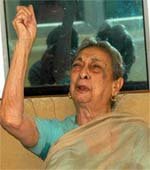
 Uzra Butt (1917-2010) was a luminous and influential theatre personality whose remarkable seven-decade career gracefully spanned the artistic landscapes of both India and Pakistan. Born Uzra Mumtaz in 1917 into an aristocratic Rohilla Pathan family in Rampur, she, along with her celebrated sister Zohra Sehgal, became a trailblazer for women in the performing arts. Growing up in a progressive environment, the sisters defied conservative norms to pursue their passion for the stage.
Uzra’s professional journey began in 1937 when she and Zohra joined Uday Shankar’s pioneering ballet company. This role took them across Europe and the United States, providing them with invaluable international exposure and training. When World War II forced their return to India, Uzra’s career entered its most iconic phase. In 1944, after a stint with the Indian People’s Theatre Association (IPTA), she caught the eye of the legendary Prithviraj Kapoor. He cast her as the leading lady for his newly formed Prithvi Theatre, a position she held with distinction until 1960.
During her time with Prithvi Theatre, Uzra became the face of the company, starring as the heroine in countless productions. Her acclaimed performances in plays like Sakuntala, Ghaddar (alongside Zohra), Kisan, and Pathancemented her reputation as a formidable actress. Beyond her on-stage presence, she served as the theatre’s art director, contributing significantly to its creative vision and management. Performing in over 2,500 shows across more than 100 Indian cities, she was instrumental in establishing Prithvi Theatre as a cornerstone of the subcontinent’s theatrical tradition.
In 1964, following her marriage to Hameed Butt, Uzra migrated to Pakistan. After a period of intermittent work, her career experienced a powerful renaissance in 1985 when she joined the Lahore-based Ajoka Theatre, eventually becoming its chairperson. With Ajoka, she delivered commanding performances in socially relevant plays such as Chaak Chakkar, Dukh Darya, and Barri, helping to pioneer alternative theatre in Pakistan.
The most poignant moment of her later career was the historic 1993 reunion with her sister Zohra for the play Ek Thi Nani (There Was Once a Grandmother). Written by Shahid Nadeem, the play was inspired by the sisters’ own lives and their painful 40-year separation caused by the Partition of India. The production, which toured India, Pakistan, and Britain to great acclaim, served as a powerful testament to their shared heritage and the enduring bonds of family torn apart by political borders.
In recognition of her immense contribution to Urdu theatre, the Indian government bestowed upon her the prestigious Sangeet Natak Akademi Award in 1994, a rare and significant honour for a Pakistani artist. Uzra Butt’s final stage performance was in 2008, and she passed away in Lahore in 2010 at the age of 93. Her life and work symbolise a cosmopolitan, secular cultural tradition that predated Partition, and she remains an enduring cultural bridge between India and Pakistan, remembered as one of the grand dames of the subcontinent’s stage.