
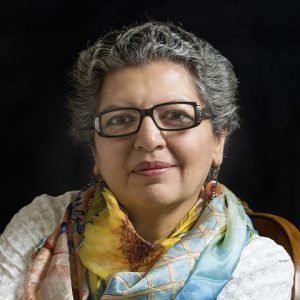
 Rana Safvi is one of contemporary India’s most significant historians, writers, and translators, celebrated for her passionate advocacy of the nation’s pluralistic heritage, particularly the syncretic culture known as Ganga-Jamuni Tehzeeb. Her life’s work has been dedicated to documenting and preserving the harmonious blend of Hindu and Muslim traditions that have shaped India’s composite civilisation.
Born in Aligarh, Safvi’s early life was marked by exposure to India’s cultural diversity, a result of her father’s career as an Indian Police Service (IPS) officer. She was educated at distinguished institutions, culminating in a Master’s degree in Medieval History from Aligarh Muslim University. She recalls her youth as a time when religious identity was a private affair, allowing the Ganga-Jamuni Tehzeeb to flourish genuinely. After marrying, she embarked on a teaching career that took her to various parts of India and the Middle East. It was only upon her return to India at age 55 that she began her profound literary journey, feeling a calling to chronicle the stories of Delhi.
Safvi’s emergence as a writer was remarkable; she published her first book at 58. Her most acclaimed work is The Delhi Trilogy, a comprehensive exploration of the capital’s rich past through its successive cities. Comprising “Where Stones Speak,” “The Forgotten Cities of Delhi,” and “Shahjahanabad,” the trilogy combines meticulous historical narrative with evocative Sufi couplets, bringing the city’s monuments and stories to life. She has also ventured into historical fiction with “A Firestorm in Paradise,” a novel set during the 1857 uprising. A crucial aspect of her work is the translation of seminal Urdu historical texts, such as Sir Syed Ahmad Khan’s Asar-us-Sanadid and Zahir Dehlvi’s Dastan-e-Ghadar. By making these primary sources accessible in English, she offers nuanced perspectives that challenge colonial-era historical narratives.
Beyond traditional scholarship, Safvi is a dynamic cultural advocate in the digital age. She founded the #Shair movement on Twitter, a popular hashtag that has successfully revived widespread interest in Urdu poetry. Her blog, “Hazrat-e-Dilli,” serves as a rich repository of information on Delhi’s heritage, culture, and traditions, making scholarly insights accessible to a broader audience. Her expertise also extends to food heritage, where she has contributed to projects documenting the culinary history of Awadh.
Central to Safvi’s work is her deep-seated belief in Ganga-Jamuni Tehzeeb. She defines this not as a melting pot where cultures dissolve into one, but as a confluence, like the Ganga and Yamuna rivers, where distinct traditions meet and coexist while retaining their unique identities. Her scholarship is a testament to this philosophy, unearthing historical evidence of Hindu-Muslim synthesis in festivals, architecture, and courtly life. For her tireless efforts, Safvi has received numerous accolades, most notably the Yamin Hazarika Woman of Substance Award in 2020, which specifically honoured her contribution to India’s syncretic culture.
In an era of increasing religious polarisation, Rana Safvi’s work serves as a vital reminder of India’s rich history of communal harmony and cultural integration. By bridging academic research with public engagement, she ensures that the legacy of this composite culture remains visible, understood, and celebrated, thereby solidifying her position as an indispensable guardian of India’s pluralistic heritage.