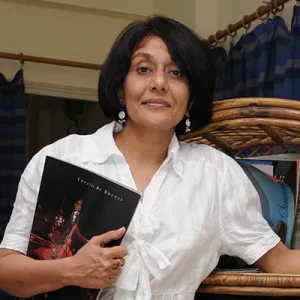
 Mariam Karim-Ahlawat is a distinguished and versatile figure in contemporary Indian literature, celebrated as a prolific author, playwright, and educator. Her extensive body of work, which encompasses award-winning novels, acclaimed plays, and a rich collection of children’s literature, establishes her as a significant voice whose writing consistently engages with critical social, cultural, and environmental themes.
Born in Lucknow into a distinguished military family, her upbringing involved extensive travel across India. This exposure, coupled with a formidable education at Jawaharlal Nehru University (JNU) in New Delhi and the Sorbonne in Paris, cultivated a unique multicultural perspective. Holding three postgraduate degrees in French Literature and Pedagogy, her worldview was further shaped by her father, Major General Afsir Karim, a renowned military strategist and scholar. This background of intellectual rigour and geopolitical awareness permeates her creative works. Her academic career as a pedagogue of French has seen her teach at numerous prestigious institutions, including JNU and Alliance Française.
Karim-Ahlawat’s literary career was launched with her debut novel, My Little Boat (2003), a poignant exploration of identity and social conflict in post-Babri Masjid India, which earned nominations for the IMPAC International Award and the Hutch Crossword Award. Her second novel, The Street of Mists, set in Paris, continued this success, being longlisted for the Man Asian Prize in 2009 for its exploration of art, freedom, and cultural identity. Her talent extends powerfully to theatre, with plays like The Betrayal of Selvamary and Fractals Search for the Real being shortlisted and longlisted for the Hindu Metro Plus Playwright Award.
A significant portion of her legacy lies in children’s literature, where she has been a pioneering voice for over two decades. Starting with Tales Old and New (1994), she has authored numerous beloved books, such as Putul and the Dolphin and Gulla and the Hangul. Her stories, often set against specific Indian landscapes like the Ganga plains or Kashmir, seamlessly weave in themes of environmental conservation and folklore. Many of her works are published bilingually and in multiple Indian languages, making them widely accessible.
Her commitment to social issues is evident in specialised projects. She collaborated with Johns Hopkins University to write and edit five books for children affected by HIV, which were distributed freely through NGOs. Furthermore, she has contributed extensively to educational discourse through her involvement in creating multimedia content for children and by writing a long-standing column on education and social issues for The Times of India.
Across all genres, Karim-Ahlawat’s writing is marked by a distinct cinematic quality and a deep thematic consistency. Her narratives frequently delve into women’s struggles and empowerment, the complexities of cultural identity, social justice for marginalised communities, and the vital relationship between humanity and nature. As a Muslim woman writer with a profound understanding of French literature, she brings a unique cross-cultural lens to Indian writing. Through her extensive workshops and publications, she champions the intrinsic value of childhood and advocates for treating children with respect, leaving an indelible mark on literature and education in India.