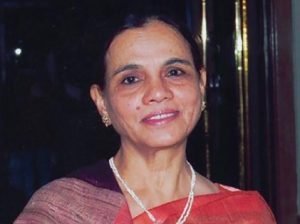
 Begum Razia Baig (1951-2024) was a formidable figure in Hyderabad’s theatrical world and a pivotal force behind the city’s theatre revival movement. As the chairperson and co-founder of the Qadir Ali Baig Theatre Foundation, she dedicated her life to preserving and promoting quality theatre, earning a reputation as a “theatre matriarch” who mentored generations of artists and brought Hyderabadi cultural heritage to a global audience.
Born into a traditional Hyderabadi business family, Razia Baig’s life path was redefined by her marriage to Qadir Ali Baig, who hailed from an aristocratic polo-playing family. The couple resided at the historic Ahmed Bagh Palace. Initially, Razia Baig was uncertain about her husband’s decision to leave behind his family’s legacy of polo and horse racing for the world of theatre. However, she soon became his steadfast partner, helping adapt Hindi plays into Hindustani for local audiences and designing costumes. Her refined aesthetic sensibilities shaped not only their theatrical productions but also their legendary ancestral home and gardens.
During the “golden era” of Hyderabadi theatre from 1970 to 1984, Razia and Qadir Ali Baig, through their New Theatre Hyderabad (NTH), created spectacular historical pageants and socially relevant dramas that remain etched in the city’s cultural memory. Tragically, Qadir Ali Baig passed away in 1984 at the young age of 46. Following his death, Begum Razia Baig took on the monumental task of raising her three sons while keeping her husband’s theatrical legacy alive. She successfully guided all three of her sons, Moin Ali Baig, Mohammad Ali Baig, and Afzal Ali Baig, into becoming respected theatre personalities, with Mohammad Ali Baig later receiving the Padma Shri award in 2014.
In 2005, the Qadir Ali Baig Theatre Foundation was formally established as a tribute to the late theatre doyen. Begum Razia Baig served as its chairperson, with her son Mohammad Ali Baig as the president and curator-director. Under her leadership, the foundation produced internationally acclaimed, heritage-oriented historical spectacles such as “Quli: Dilon ka Shahzaada,” “Savaan-e-Hayat,” and “1857: Turrebaz Khan.” These productions were invited to prestigious venues like the University of Oxford and the Edinburgh Festival, highlighting the foundation’s global reach.
A cornerstone of her enduring legacy is the annual Qadir Ali Baig Theatre Festival, which she co-curated for 18 editions. The festival has grown to become one of India’s most prestigious theatre assemblies and the largest of its kind in the subcontinent, consistently featuring renowned performers from India and abroad.
Beyond the stage, Begum Razia Baig was celebrated for her expertise in authentic Hyderabadi cuisine. She authored columns on traditional cooking for leading newspapers, sharing recipes and culinary traditions passed down through her family. Her knowledge of old-world dishes made her a sought-after consultant and a legendary hostess, known for her elaborate meals and tea parties for visiting dignitaries and theatre luminaries.
Razia Baig was remembered by her family and peers for her graceful and dignified demeanour, embodying the quintessential Hyderabadi tehzeeb (etiquette). She was a private yet fiercely supportive individual who championed her “theatrical family” with unwavering dedication. She continued to work with the foundation until her final days, passing away on March 24, 2024, at the age of 73. Her legacy lives on through the Qadir Ali Baig Theatre Foundation, the festival she helped build, and the countless artists she mentored. Following her death, her son Mohammad Ali Baig launched the “Remembering Razia Baig” series to honour women in the performing arts, a fitting tribute to a woman who quietly and powerfully shaped the world of theatre from the shadows.