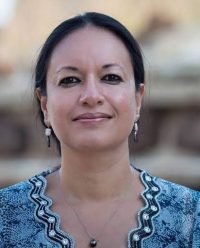
 Dr. Nyla Ali Khan is a distinguished academic, author, and women’s rights advocate known for her influential work on Kashmir and gender issues. Born in New Delhi in 1974, her unique background as the granddaughter of Sheikh Mohammad Abdullah, the first Muslim Prime Minister of Jammu and Kashmir, provides her with a crucial link between the region’s historical political legacy and contemporary academic discourse.
Dr. Khan’s family is one of Kashmir’s most politically significant. Her grandfather, Sheikh Mohammad Abdullah, was a key leader in the region’s independence movement. Her mother, Suraiya Abdullah Ali, is a retired literature professor, and her father, Dr. Mohammad Ali Matto, was a retired physician. Her family lineage also traces back to a Brahmin ancestor who converted to Islam in the 19th century. Dr. Khan’s grandmother, Begum Akbar Jehan Abdullah, was also a notable political activist and is the subject of one of her most significant books.
Her educational journey began at Lady Shri Ram College in New Delhi before she moved to the United States in 1998. She earned both her Master’s and Ph.D. in English Literature from the University of Oklahoma, a period she credits with helping her find her voice. She has held various academic positions, including her current role as an adjunct professor at Oklahoma City Community College, and has also taught at the University of Oklahoma and the University of Nebraska-Kearney.
Dr. Khan has authored six books and numerous articles, establishing herself as a leading expert on Kashmir studies, women’s rights, and South Asian politics. Her major works include:
-
The Fiction of Nationality in an Era of Transnationalism (2005): A critical analysis of how South Asian life is portrayed in the works of prominent authors like V.S. Naipaul and Salman Rushdie.
-
Islam, Women, and Violence in Kashmir: Between India and Pakistan (2010): An examination of how gender, religion, and conflict intersect in Kashmir, praised for its nuanced analysis of women’s experiences in war zones.
-
The Life of a Kashmiri Woman: Dialectic of Resistance and Accommodation (2014): A biographical work about her grandmother, offering a personal look at her pivotal role in Kashmir’s political history.
-
Sheikh Mohammad Abdullah’s Reflections on Kashmir (2018): A compilation of her grandfather’s speeches and writings, serving as an important historical resource.
- Educational Strategies for Youth Empowerment in Conflict Zones (2020): This book proposes innovative methods for education in conflict-affected regions, drawing on her expertise in both educational theory and conflict studies.
- Writings About Kashmir: Illuminating the Labyrinthine Region (2022): An edited volume that brings together various perspectives on Kashmir.
She has also edited The Parchment of Kashmir and published dozens of articles in academic journals and other publications.
Dr. Khan’s commitment to social justice is evident in her advocacy and public service roles. In 2015, she became the first Kashmiri woman to be accepted onto the Advisory Council for the Oklahoma Commission on the Status of Women, later becoming a Commissioner. This role allows her to influence policies that improve the lives of women, children, and families in Oklahoma.
Her advocacy extends to women’s rights, particularly empowering women in conflict zones and addressing challenges faced by Muslim women. She gives presentations at women’s correctional facilities and is an active member of the multicultural Women’s Interfaith Alliance. She also serves on the board of Generation Citizen, a nonprofit focused on civics education for youth.
Throughout her career, Dr. Khan has received numerous honours, including the Oklahoma Human Rights Award (2016) and the President’s Volunteer Service Award (2018). She was also recognised as one of the Oklahoma League of Women Voters’ 100 Trailblazers and has been featured in The Journal Record’s “50 Making a Difference” for three consecutive years.