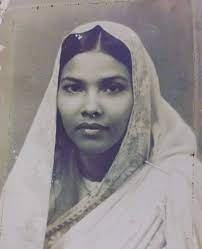
 M. Haleema Beevi (1918-2000) was a trailblazer from Kerala whose life’s work was dedicated to social reform, journalism, and the empowerment of women, particularly within the Muslim community. Despite her profound contributions, her legacy was largely overlooked for decades, a subject of what has been described as historical “double marginalisation.”
Born in 1918 in Adoor, Kerala, to Peer Mohammed and Maideen Beevi, Haleema Beevi’s upbringing was atypical for her time. After her father’s death, her mother, a widow, made the bold decision to send her to school, defying the conservative social norms that restricted girls’ education. This early exposure to education laid the foundation for her future work. She married K.M. Mohammed Moulavi, a respected writer and religious scholar who was a disciple of the social reformer Vakkom Moulavi. Unlike many of his peers, Mohammed Moulavi was a staunch supporter of his wife’s intellectual and political pursuits, encouraging her to write and publish. The couple had five children: Ansar Begum, Nafisa Beevi, Jameela Beevi, Mohammad Ashraf, and Ayesha.
Haleema Beevi’s activism emerged from a society where Muslim women were largely confined to their homes and denied formal education. She identified the power of journalism as a tool for social change and dedicated her life to using it to challenge deeply entrenched orthodoxies.
-
Pioneering Women’s Journalism: She is widely regarded as one of the first female journalists in Kerala. She launched and edited several influential magazines that became platforms for feminist thought and social critique. Her publications include:
- Muslim Vanitha (The Muslim Woman), a monthly launched in 1938.
- Vanitha (Woman), a weekly magazine, which was started in 1944.
- Adhunika Vanitha (The Modern Woman), which began publication in 1970.
Her writings in these magazines advocated for women’s education, personal freedom, and their active participation in society. She used her editorials to challenge religious leaders and conservative elements who issued fatwas against girls’ schooling.
-
Political and Social Activism: Haleema Beevi was a formidable political figure. At the age of 20, she was elected as a Municipal Councillor in Thiruvalla, becoming the first Muslim woman to hold such a position in Kerala. Her political career was intertwined with the Indian freedom struggle, and she was arrested for her involvement in nationalist activities. She also actively participated in the Vimochana Samaram (Liberation Struggle) against the first Communist government of Kerala. As the President of the Thiruvalla Muslim Women’s Association, she mobilised women to work towards social and political causes.
While she was a prolific writer, her literary legacy is primarily preserved in the thousands of articles, editorials, and short stories she penned for her own publications and others. She did not publish books in the traditional sense, but her journalistic work had a profound and lasting impact. She used her pen to promote a progressive and nationalist perspective, challenging both colonial rule and internal social injustices. The themes of her writings often focused on the economic, political, and social self-reliance of women.
Perhaps the most poignant aspect of Haleema Beevi’s story is the lack of formal recognition she received during her lifetime. Her contributions were largely forgotten by mainstream history, and she was denied the state and national honours that her male contemporaries received. This historical oversight is attributed to her identity as a Muslim woman who challenged social norms and religious orthodoxy, making her a “double outsider.” Her legacy was further obscured by the fact that historical narratives were often dominated by upper-caste, male perspectives. In recent years, scholars and biographers have begun to rediscover her life’s work, seeking to restore her rightful place as a pioneer.