
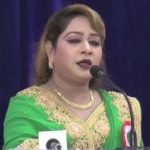
 Ana Dehlvi, born Rubina Khan in 1982, is a distinguished contemporary Urdu poet from Delhi, India. She has carved a significant niche for herself in modern Urdu literature, celebrated both for her written collections and her captivating performances at poetic symposiums, or mushairas, across the globe.
Although born in Aligarh, Ana Dehlvi was raised in Delhi. Her family background was a blend of medicine and politics; her mother was a doctor who was also active in the Congress party. Following the political shifts after Indira Gandhi’s assassination, the family briefly relocated to Kanpur. Her maternal roots trace back to a culturally rich Sunni Syed family from Lucknow, a city renowned for its literary heritage. It was from this lineage that she inherited her poetic talent. Poetry came to her naturally, and she began composing short couplets at the tender age of eight. Recognising her innate gift, her mother nurtured this talent by introducing her to the works of classical Urdu masters like Ghalib, Daag, and Jigar. This early immersion in classical literature provided her with a strong foundation in traditional poetic forms and meters, which would later inform her own unique style.
Dr. Ana Dehlvi, who holds a doctoral degree for her contributions to Urdu literature, has an impressive body of work. She has published several poetry collections that have been well-received in literary circles. Her first major collection, “Rang-e-Ana,” was published in 2003, followed by “Uske Nam Ki Aadhi Zindagi” in 2010. Other notable works include “Tum Bin.” Her seventh and most recent collection, “Aabroo-e-Ghazal” (2024), underscores her continued relevance and was launched at a prestigious ceremony at Aligarh Muslim University (AMU), a premier centre for Urdu studies in India.
Beyond her published works, Ana Dehlvi is famous for her dynamic and expressive recitations at mushairas. Her career as a performer began in 1995 and has taken her to prestigious stages within India, such as the historic Lal Qila Mushaira in Delhi, and to numerous international venues.
Dehlvi is particularly acclaimed for her ghazals, a poetic form she uses to explore profound emotional landscapes. Her poetry explores timeless themes of love, loss, separation, and the complexities of the human experience. Verses like “Pehle jo thi dilon mein mohabbat nahin rahi” (The love that once existed in hearts is no more) resonate deeply with audiences for their emotional honesty and elegant expression. She masterfully blends the sophistication of classical Urdu poetry with a contemporary sensibility, making her work accessible and relatable to a modern audience. Her influence has even touched popular culture, with one of her compositions’ tunes being adapted for the Bollywood film “Dabangg 2.”