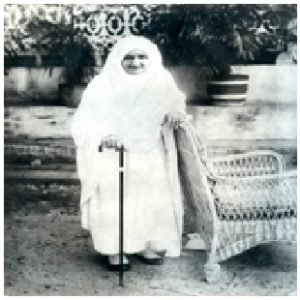
 Abadi Bano Begum (popularly known as Bi Amma) was the first Muslim woman to actively participate in the freedom struggle for independence. She hailed from Amroha Village, Uttar Pradesh, but her primary activities were centred in Amritsar and Lahore. She was born in 1850 and married Abdul Ali Khan of Rampur state. Her husband died at the young age of thirty due to cholera. She pledged her jewellery to educate her children in an English-medium school. She was the mother of the Ali brothers (Mohammad Ali & Shaukat Ali), leading leaders of the Khilafat Movement and the freedom struggle. She was an active member of the Khilafat Committee. She addressed a meeting at Lahore and analysed the follies of Indians committed by supporting English rule over the mother country and causing its slavery.
 She joined a demonstration for the release of Annie Besant and her two sons, Muhammad Ali and Shaukat Ali, who were in prison for their anti-British activities. She advocated the use of Khadi (Indian homespun cotton) and Hindu-Muslim unity. She toured Rawalpindi, Gujranwala, Kasur, and many other places in the country, appealing to women to use Khadi. In her address in Punjab, she urged the people to work collectively for the attainment of the Swaraj (Self-government) and leave this Swaraj for the upcoming generations instead of property and wealth. She addressed a ladies’ conference in Bombay and insisted they join the freedom struggle. During the Non-Cooperation movement, she toured Patna and Bhagalpur and collected sixty thousand rupees from Darbhanga, Bihar, for the Khilafat Committee in February 1922. She kept on working for the freedom of the country till her death in 1924. To commemorate her contribution towards the freedom struggle, the Pakistan government issued a postal stamp in 1990.