
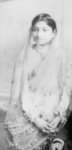
 Amina Abbas Tyabji (1866-1942) was a formidable force in India’s struggle for independence and a pioneer in women’s education. Born on 15 May 1866 into one of Bombay’s most distinguished political families, she was the daughter of Badruddin Tyabji, the first Indian barrister at the Bombay High Court and the third President of the Indian National Congress. Her mother, Rahat-un-Nafs, was a progressive figure who organised inter-community zenana gatherings. From this environment, Amina internalised the two pillars of her life’s work: the necessity of female education and the imperative of national self-determination.
Amina married Abbas Tyabji, who served as the Chief Justice of Baroda State. While Abbas is famously remembered as the “Grand Old Man of Gujarat” and Gandhi’s successor in leading the Salt Satyagraha, Amina carved out an independent and influential sphere of action. She was a committed political activist in her own right, serving on the Subject Committee of the Indian National Congress and travelling frequently to Ahmedabad for meetings.
In April 1930, she joined her daughter Raihana and 28 other women in co-signing a bold letter to the Viceroy, declaring solidarity with the civil disobedience campaign and pledging to boycott foreign cloth. The family’s commitment to the Swadeshi movement was absolute; they famously consigned their finest foreign linens and Irish lace to nationalist bonfires—a symbolic repudiation of colonial commerce.
Amina’s bond with Mahatma Gandhi was deeply personal. While imprisoned in 1930, Gandhi wrote to the prison authorities naming Amina as someone who was “like a blood relation,” insisting she be granted the same visitation rights as his own wife, Kasturba.
The Educator of Baroda
Amina’s most enduring legacy was her work in Baroda, where the education of Muslim girls was severely neglected. Recognising that the community was a numerical minority with few resources, she personally raised funds by tapping into family networks and community goodwill. She provided the initial building for a school for Muslim girls and worked tirelessly to elevate it to the Matriculation standard. Her vision extended far beyond her lifetime; before her death in 1942, she had already laid the groundwork for the institution to transition into a full-fledged women’s college. Today, her efforts remain a cornerstone of female literacy in the region.
A Legacy of Service
The Tyabji household was a crucible for public service, and Amina’s children continued this tradition:
-
Sharifa Hamid Ali: A founding member and President of the All-India Women’s Conference and India’s representative to the UN Commission on the Status of Women.
-
Raihana Tyabji: A celebrated devotional singer and author who was imprisoned multiple times during the Non-Cooperation Movement.
-
Sohaila Tyabji: Mother of the eminent historian Professor Irfan Habib.
-
Dr Salahuddin Tyabji: A civic leader in Rangoon whose son, Captain Nadir Tyabji, assisted in the evacuation of Indians from Burma during WWII.
Amina died in Vadodara in 1942. Despite her monumental contributions, her name often eludes mainstream history books—a result of the Tyabji women’s characteristic modesty and “chariness of publicity.” She remains a quintessential nation-builder who sustained the moral and intellectual fabric of the independence movement through education and organised protest.