
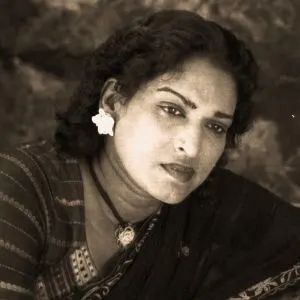
 Amirbai Karnataki (c. 1906–1965), revered as “Kannada Kokila,” was a pioneering Indian playback singer and actress whose work bridged the worlds of classical music and early Indian cinema. Born in Bilgi, Bijapur district (now in Karnataka), Amirbai came from a family deeply immersed in the performing arts—her father was a tabla player, and her mother was a theatre actress. She was one of several siblings, with her eldest sister, Gauharbai, also a notable actress.
Amirbai received intensive training in Hindustani classical music from a young age. Her early exposure included rigorous learning in forms such as khyal, thumri, dadra, ghazal, and qawwali. She was known for her flexible, emotive voice, described as powerful, unique, yet sweet, with an impressive range and clarity. Though not tied to a formal gharana, her singing deeply reflected traditional classical roots while demonstrating impressive versatility. Amirbai could perform classical, folk, devotional, and even Western-influenced music across several languages (Hindi, Kannada, Gujarati, Marathi).
Her music career began after a representative from His Master’s Voice (HMV) heard her sing and invited her to record. While her initial film appearances were in the early 1930s, real fame came with the 1943 film Kismet, whose patriotic songs, especially “Door Hato Ae Duniyawaale,” became national favourites during India’s independence movement. She also gained widespread recognition for singing “Vaishnav Jan To” in “Narsi Bhagat,” a rendition esteemed by Mahatma Gandhi.
During her peak (1943–1947), Amirbai was among the highest-paid singers in India, collaborating closely with composers such as Anil Biswas. She contributed to over 150 films with approximately 380 songs. Other notable film songs include “Gore Gore O Banke Chhore” (duet with Lata Mangeshkar), “Milke Bichhad Gai Ankhiyan,” and several beloved regional songs. Her impact extended to music composition for the film “Shehnaaz” (1948) and performances in theatre and cultural programs, notably in North Karnataka. She also established the Amir Talkies cinema hall in Bijapur.
Despite professional success, Amirbai’s personal life was difficult. Her first marriage was marred by domestic violence, from which she escaped with legal assistance. Her second marriage, to magazine editor Badri Kanchawala, was much happier. Her life and struggles are documented in the biography “Amirbai Karnataki: The Life and Times of a Songstress” by Rahamath Tarikere, as well as works by Prashant Kulkarni.
With the rise of new singers like Lata Mangeshkar, Amirbai transitioned to supporting roles in films. She passed away in 1965 following a paralytic attack but left a lasting legacy in Indian music. Amirbai Karnataki remains a crucial figure who helped shape the early traditions of Bollywood playback singing, seamlessly blending classical artistry with the changing trends of Indian cinema. Her recordings and story continue to inspire new generations of musicians and music lovers.