
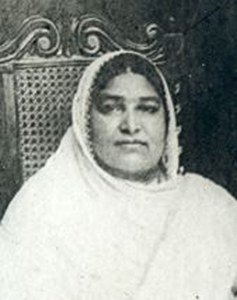
 Amjadi Begum (1885-1947), born Amjadi Bano Begum, was a formidable Indian freedom fighter, political leader, and journalist whose public life intersected with the most pivotal moments of the twentieth-century independence struggle. Born in Rampur, United Provinces, into a family rooted in state administration, she was educated at home in religious and literary traditions. In 1902, she married her cousin, Maulana Muhammad Ali Jauhar, a towering figure who co-founded the All-India Muslim League and led the Khilafat Movement. Alongside her mother-in-law, the legendary Abadi Bano Begum (Bi Amma), Amjadi Begum emerged from the domestic sphere to become a vanguard of Muslim women’s political activism.
Leadership in the Khilafat and Non-Cooperation Eras
Amjadi Begum’s political ascent began during the Khilafat agitation (1919–24). As Secretary of the women’s wing of the All-India Khilafat Committee, she travelled extensively with Bi Amma, raising a staggering forty lakh rupees for the cause. Her influence was so pronounced that the Governor of the United Provinces noted with frustration the “unrest” incited by the women of the Jauhar household. Her oratorical brilliance did not go unnoticed by Mahatma Gandhi, who, in a 1921 article titled “A Brave Woman,” praised her courage and skill as being equal to that of her husband.
Beyond rhetoric, she was a pragmatist committed to the swadeshi movement. Representing Uttar Pradesh at the 1921 All-India Congress Working Committee meeting, she championed khadi and established a Khadi Bhandar in Aligarh to foster economic self-reliance among women. Her activism bridged the gap between elite political discourse and grassroots mobilisation, proving that women were essential to the success of mass movements.
Late Career and the Path to Independence
In 1930, she accompanied her husband to the First Round Table Conference in London. Following his death in 1931, she continued her political journey with fierce independence from her home in Delhi. At the invitation of Muhammad Ali Jinnah, she became the sole woman on the twenty-five-member Working Committee of the All-India Muslim League. A historic figure in the party, she was present for the 1940 Lahore Resolution; notably, she is credited by contemporary editors as the first to label it the “Pakistan Resolution.”
Her leadership extended to presiding over the League’s women’s wing in Patna and Lucknow. In the 1946 general elections, her decades of service culminated in her unopposed election to a legislative seat from Uttar Pradesh. Beyond the ballot box, she was a dedicated educator and journalist, founding the Hameedia Girls’ School in Allahabad and editing the Urdu daily Roznama Hind. She also managed the affairs of Jamia Millia Islamia during periods of political upheaval to ensure the institution’s survival.
Amjadi Begum died on March 28, 1947, just months before the independence she had spent her life pursuing. Jinnah described her passing as a profound loss to the nation. Her legacy remains that of a trailblazer who transitioned from the traditional world of the late nineteenth century to the corridors of modern power, serving as an orator, institution-builder, and elected representative who actively shaped the direction of South Asian history.