
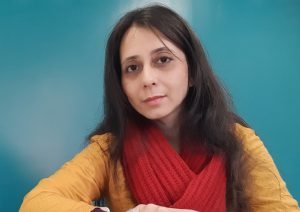
 Annie Zaidi is a distinguished and versatile Indian writer whose work in English has established her as a formidable literary force. Spanning journalism, non-fiction, fiction, playwriting, and filmmaking, her career is marked by a consistent and unflinching exploration of identity, home, belonging, and dislocation in contemporary India. Her voice has become particularly significant for its focus on marginalised communities and the complex realities of urban and rural life.
Zaidi’s profound literary sensibilities are rooted in a rich family heritage. Raised by a mother who was an educator and poet, she is also the granddaughter of the celebrated Urdu poet and scholar Syed Ali Jawad Zaidi, a Padma Shri laureate. This intellectual environment profoundly shaped her artistic development. After an education in Rajasthan and Ajmer, she pursued mass communication in Mumbai, an experience she credits with broadening her perspective and transforming her from a “small-town girl” into a writer with a more worldly view.
She began her career as a journalist, working for publications like Mid-Day and Frontline. During this period, she launched her influential blog, “Known Turf,” which later formed the basis of her debut non-fiction collection. Known Turf: Bantering with Bandits and Other True Tales (2010) was shortlisted for the Vodafone Crossword Book Award and praised for its powerful storytelling and incisive reporting on subjects like the Dalit experience in Punjab. Her journalistic eye for detail and commitment to social inquiry remain hallmarks of her creative work.
Zaidi’s transition to a major literary figure was cemented by her success across multiple genres. Her debut novel, Prelude to a Riot (2019), a multi-voiced narrative exploring rising communal tensions in a South Indian town, won the Tata Literature Live Award for Fiction and was shortlisted for the prestigious JCB Prize for Literature. Her recent novella, City of Incident (2022), further demonstrates her skill in capturing the fragmented, often invisible lives within a metropolis.
Perhaps her most globally recognised work is the essay that became the memoir Bread, Cement, Cactus (2020). This powerful piece on home and displacement won the coveted $100,000 Nine Dots Prize in 2019, catapulting her onto the international stage. The work masterfully blends personal memoir with sharp social commentary, examining internal migration and the precarious nature of belonging in modern India.
Beyond prose, Zaidi is an accomplished playwright and filmmaker. Her play Untitled-1 won The Hindu Playwright Award in 2018, and her radio script Jam was a regional winner of the BBC’s International Playwriting Competition. This versatility underscores her dynamic approach to storytelling, adapting her medium to best suit the narrative.
Currently pursuing a PhD in Creative Writing at Durham University, Zaidi continues to evolve, researching the representation of witches in South Asian fiction. Her work consistently challenges conventions, blending genres and shedding light on the often-overlooked corners of Indian society. Through her nuanced and empathetic lens, Annie Zaidi has become a vital chronicler of the Indian experience, interrogating what it means to belong in a nation undergoing profound and often turbulent change.