
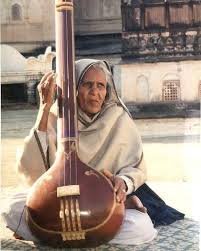
 Asgari Bai (1918-2006) was a distinguished Indian vocalist and one of the greatest exponents of the Dhrupad genre of Hindustani classical music. Her life was one of remarkable artistic achievement, marked by deep personal struggle and a late-career resurgence that cemented her legacy as a master musician.
Born in Bijawar, Madhya Pradesh, Asgari Bai was immersed in music from birth. She belonged to a family of court singers; her mother, Nazir Begum, was the court singer for the Bijawar royal family, and her grandmother, Balayat Bibi, held the same position in the Ajaigarh princely state. This rich heritage provided the foundation for her musical journey. She began her formal training at the age of eight under the tutelage of Ustad Zahur Khan, a prominent Dhrupad singer. After fifteen years of rigorous and dedicated training, she acquired extraordinary expertise and became the main court singer for the Orchha State, a position she held until she was 35.
Asgari Bai’s singing style was rooted in the Dhrupad tradition, a meditative and ancient form of Hindustani music known for its intricate improvisational introductions (alap). She was renowned for her exceptional control over rhythm (tala) and breath, as well as her complex delineation of ragas. Although not formally affiliated with a specific gharana (a school of musical lineage), her style was sometimes associated with the Mewati gharana. She was also noted for her versatility, skillfully blending the pure Dhrupad form with semi-classical genres like chaiti, kajri, and thumri.
Her life took a difficult turn after her marriage to a textile mill manager and his subsequent death in 1958. Left to raise eight children on her own, she returned to Tikamgarh and faced immense financial hardship, resorting to selling pickles to support her family. After years of obscurity, her career experienced a remarkable resurgence in 1981, at the age of 63, when she gave a powerful public performance at the Allauddin Khan Sangeet Samaroh in Gwalior. This event brought her national and international acclaim.
In recognition of her profound contributions to music, Asghari Bai was honoured with some of India’s most prestigious awards, including the Tansen Samman (1985), the Sangeet Natak Akademi Award (1987), and the Padma Shri (1990). Despite this high praise, her later years were plagued by health issues and financial difficulties, a situation so dire that she once expressed a desire to sell her awards.
Asgari Bai passed away in 2006, leaving an indelible mark on Indian classical music. Her story, a blend of artistic brilliance and personal resilience, was captured in the 1998 documentary Ashgari Bai.