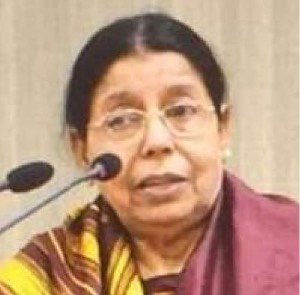
 Professor Ashraf Rafi, born on August 4, 1940, in Hyderabad, emerged from the city’s rich Urdu milieu to become one of contemporary India’s most distinguished scholars of Urdu literature. Over a career spanning more than five decades, she has made invaluable contributions as a critic, poet, academic, and mentor, dedicating her life to the advancement and preservation of Urdu studies.
Professor Rafi’s academic journey was deeply rooted in her upbringing. Raised in a learned family, she was immersed in the Deccan’s composite linguistic culture, absorbing Urdu, Telugu, Persian, and Arabic. After her initial schooling, she pursued higher studies at Osmania University, where the city’s syncretic literary circles fostered her lifelong interest in Deccani literature and the role of women in Urdu literature.
Her professional life was centred at Osmania University, where she joined the Department of Urdu in the early 1960s. She eventually rose to become the Head of the Department, a position she held until her retirement in 1998. During her tenure, she was instrumental in modernising the university’s syllabi and establishing research clusters focused on medieval Deccani texts. She guided dozens of MPhil and PhD dissertations, mentoring a new generation of scholars who now populate Urdu departments across India. Even in retirement, she remains a highly sought-after keynote speaker and academic resource.
Professor Rafi’s scholarly work is extensive and influential. Her research primarily focuses on Deccani literary history, where she has explored the region’s unique multilingual poetics and the cultural synthesis that defined its literature. A benchmark essay in the field, her work maps the history and cultural exchanges of Dakhni literature, paying special attention to the role of royal women as patrons. Another significant contribution lies in classical textual criticism; she meticulously edited Saiyyed Muhammad Zamin Kantoori’s long-lost, comprehensive commentary on Ghalib’s poetry, restoring hundreds of early couplets to the literary canon.
Her prolific output includes over eleven books, spanning literary criticism, research studies, poetry, and children’s literature. Key publications include her critical study, Nazm Taba-Taba (1973), and her poetry collection, Phir Se Jeena Hoga (2004). Her contributions have been widely recognised with numerous prestigious honours, including the Abul Kalam Azad Award from the Andhra Pradesh Urdu Academy (2010) and the Telangana State Award for her literary services, as well as accolades from the Delhi and West Bengal Urdu Academies.
Professor Ashraf Rafi’s legacy is defined by her tireless scholarship and mentorship. Her interdisciplinary approach, emphasising regional variations and cultural contexts, has shaped modern perspectives in Urdu literary studies, ensuring her profound and lasting impact on the field.