
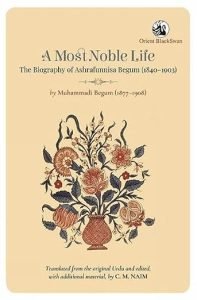
 Ashrafunnisa Begum (1840–1903), historically revered as ‘Bibi Ashraf‘ or by her honorific title ‘Ustani Sahiba‘ (The Lady Teacher), stands as a monumental figure in the history of social reform and female education in colonial North India. Born into a milieu where female literacy was viewed with deep suspicion, she transformed her personal struggle for knowledge into a lifelong mission to empower others. Her life story serves as a testament to the resilience of early Muslim women reformers who, through quiet defiance and steadfast service, laid the groundwork for generations of girls to enter public life.
Early Life and the Pursuit of Knowledge:
Ashrafunnisa was born on September 28, 1840, in Bahnera, a small town in the Bijnor district of present-day Uttar Pradesh. She belonged to a conservative, landowning Shia family that prided itself on male scholarship and public service but strictly enforced the seclusion of women. In her household, the patriarchs believed that literacy for girls was dangerous, associating respectability with obedience and ignorance.
Her childhood education was intentionally minimal. She received brief instruction from a young widow in domestic skills and the rote memorisation of the Quran, devoid of any explanation of its meaning. Even this modest exposure was halted when her teacher remarried, reinforcing her grandfather’s conviction that outside influences were perilous. Following the early death of her mother, Ashrafunnisa grew up under the stern authority of her grandfather and an unkind aunt, with her grandmother providing her only source of affection.
Despite this restrictive environment, Ashrafunnisa harboured an intense desire to read Urdu, the language of her daily life and literature. When her requests for tuition were met with scorn—relatives asked what a girl would ever do with literacy—she made a private, solemn vow: if she ever learned to read, she would teach anyone who sought instruction so that no one else would suffer the indignity of enforced ignorance.
Ashrafunnisa’s journey to literacy is a legendary narrative of self-education. During the family’s midday naps, she secretly gathered soot from the kitchen griddle, mixing it with water on a broken pot-lid to create ink, and fashioned pens from broom twigs. Secluded on the rooftop, she attempted to copy lines from devotional poems she had borrowed. Initially, she merely copied shapes without understanding them, often destroying her tools afterwards to avoid detection.
Her breakthrough came through a chance interaction with a younger male cousin who was struggling with his own lessons. In exchange for helping him avoid beatings from his teacher, she extracted instructions from him on the unpointed Urdu script. When he was sent away to Delhi, she kept his Urdu primer. Over months of solitary effort, she used the primer to decipher the texts she had previously copied blindly, eventually unlocking the ability to read.
The extent of her self-taught skills was revealed in the aftermath of the 1857 upheavals. When a messenger finally carried news from Bahnera to her father in Gwalior, the dispatch included a letter written by Ashrafunnisa herself. Her father was delighted, praising the letter’s detailed, newspaper-like quality and sending her gifts in admiration. This approval stood in stark contrast to the anger of other male relatives, highlighting the contested nature of women’s education even within a single family.
Marriage, Widowhood, and Independence:
In 1859, at the age of nineteen, Ashrafunnisa married Syed Alamdar Husain, a kinsman and progressive academic who taught at Government College, Lahore. Unlike the men of her childhood, Husain supported female intellectualism. The couple moved to Lahore, establishing a modest, intellectually vibrant household. However, this period of stability was cut short when Husain died of tuberculosis in 1870, leaving Ashrafunnisa a widow at thirty, responsible for her daughters in a city far from her natal home.
Initially, Ashrafunnisa upheld the traditional expectations of sharif (gentry) widows. When the Director of Public Instruction offered her a teaching post out of respect for her late husband, she accepted scholarships for her daughters but declined the job on grounds of propriety. For several years, she supported her family through sewing and embroidery. It was only in 1878, persuaded by community elders and financial necessity, that she agreed to join the Victoria Girls’ School in Lahore.
The Legacy of “Ustani Sahiba”:
Ashrafunnisa served at Victoria Girls’ School for 25 years, until her death in May 1903. The school, located in the historic Haveli of Nau Nihal Singh, was one of the few institutions offering systematic education to Muslim girls. There, she earned the affectionate title ‘Ustani Sahiba’.
Her teaching philosophy went beyond mere literacy; she focused on moral self-discipline, service to the less fortunate, and modesty without timidity. Under her guidance, the school was upgraded to the middle level, and her students consistently achieved strong examination results. She became a pillar of the community, fulfilling her childhood vow to share knowledge with any who sought it.
Her life story was immortalised through her friendship with Muhammadi Begum, a pioneering editor and writer. At Muhammadi Begum’s urging, Ashrafunnisa published the autobiographical essay “How I Learned to Read and Write” in the journal ‘Tahzib-e Niswan‘ in 1899. The essay was a searing critique of the norms that had kept her ignorant and a celebration of her triumph over them.
Ashrafunnisa Begum died in 1903, but her legacy endured through Muhammadi Begum’s biography, ‘Hayāt-e Ashraf’ (1904), recently translated into English as ‘A Most Noble Life’ (2022) by C. M. Naim. Today, she is recognised not just as a teacher but as a symbol of the transformative power of education. Her journey—from scratching letters with soot on a rooftop to becoming a revered educationist—illuminates the early stirrings of reform in colonial India and remains a beacon of resistance against patriarchal ignorance.