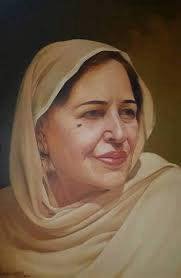
 Begum Akbar Jehan Abdullah was a distinguished Indian politician, social activist, and a pivotal figure in the political history of Jammu and Kashmir. Affectionately known as “Madr-e-Meharban” (Kind Mother) across the Kashmir Valley, she was celebrated for her compassionate leadership and unwavering commitment to her people. Her life was a blend of political struggle, social reform, and personal resilience.
Born in 1916 into an affluent European-Kashmiri family, she eschewed a life of comfort for political activism. Her father, Harry Nedou, was a European hotelier who managed the prominent Nedou’s hotel chain, and her mother, Mir Jan, came from a local Gujjar family. In 1933, she married Sheikh Mohammed Abdullah, the founder of the National Conference party and a central figure in Kashmir’s movement for autonomy. This union placed her at the heart of the region’s turbulent political landscape.
Her political career was significant. She served two terms as a Member of India’s Lok Sabha, representing the Srinagar constituency from 1977 to 1979 and the Anantnag constituency from 1984 to 1989 under the National Conference banner. However, her most profound political impact came during her husband’s long periods of incarceration. In his absence, Begum Abdullah became the face of resistance, leading the National Conference and organising protests against the ruling regime. She fearlessly led marches and demonstrations, enduring harsh state repression, including baton charges and water cannons. She was regarded as a resolute advocate for Kashmir’s self-determination, sometimes seen as even more steadfast than her husband.
Beyond politics, Begum Abdullah was a dedicated social reformer and a pioneer for women’s empowerment in a largely patriarchal society. She was the first President of the Jammu and Kashmir Red Cross Society from 1947 to 1951. She championed women’s rights and welfare through various leadership roles, including chairing the State Level Committee for the International Year of Women in 1975 and presiding over the state branches of the All India Family Welfare Association and the All India Women’s Conference. Her philanthropic efforts were aimed at helping the underprivileged, irrespective of their caste or creed.
Her family life was marked by both prominence and adversity. The Abdullah family became a political dynasty, with her son Farooq Abdullah and grandson Omar Abdullah both serving as Chief Ministers of Jammu and Kashmir. Following Sheikh Abdullah’s arrest in 1953, the family was dispossessed of their property and faced immense hardship, relying on the support of loyalists. Despite these challenges, she prioritised her children’s education and remained a symbol of strength. Passing away in 2000, Begum Akbar Jehan Abdullah left a lasting legacy as a formidable political leader, a compassionate social worker, and an icon of Kashmiri resilience.