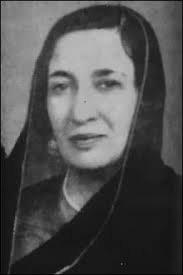
 Begum Jahanara Shahnawaz (1896–1979) was a trailblazing politician, feminist, and author who fundamentally reshaped the role of Muslim women in the political landscape of the Indian subcontinent. Born in Lahore into the influential Mian family of Baghbanpura, she was raised in a highly political environment; her father, Sir Mian Muhammad Shafi, was a co-founder of the All-India Muslim League. Educated at Queen Mary College, Jahanara entered public life early, blending her literary talents with a fierce commitment to social reform. By the age of nine, she was already published, and her 1915 novella, Husn Ara Begum, depicted a young woman choosing social reform over a forced marriage—a radical theme for the time.
Political Pioneering and the Round Table Conferences
Jahanara’s career was defined by “firsts.” In 1931, she became the first woman member of the All-India Muslim League Council. She was the only Muslim woman delegate to attend all three Round Table Conferences in London (1930–1932), where she lobbied for adult franchise and legislative quotas for women. Her collaboration with British parliamentarians on the Joint Select Committee was instrumental in drafting the Government of India Act of 1935, which successfully enfranchised over 600,000 women.
In 1937, she was elected to the Punjab Legislative Assembly and appointed Parliamentary Secretary for Education, Medical Relief, and Public Health, making her the first Muslim woman to hold an executive position in British India. Although she was briefly expelled from the Muslim League in 1941 for refusing to resign from the National Defence Council during World War II, her dedication to the war effort and women’s mobilisation remained steadfast. She was eventually reinstated by Muhammad Ali Jinnah in 1946, just in time to play a critical role in the Pakistan Movement.
Constitutional Advocacy Post-Partition
Following the Partition of India, Jahanara Shahnawaz became one of only two women in Pakistan’s first Constituent Assembly. She made history as the first woman in Asia to preside over a legislative session. Her most enduring political legacy lies in her constitutional work: she secured a three per cent quota for women in the legislature, advocated for equal pay, and was a primary architect of the Muslim Personal Law (Shariat) Act of 1948. This landmark legislation legally recognised the right of Muslim women to inherit property, a cause she had championed since moving a resolution against polygamy in 1918.
Her family continued her legacy of public service; her daughter, Mumtaz Shahnawaz, was a noted diplomat and author of The Heart Divided, while her daughter, Nasim Jahan, also entered politics. Jahanara’s own political autobiography, Father and Daughter (1971), remains a vital primary source for historians of the era. Until her death in 1979, she remained a tireless advocate for the Charter of Women’s Rights. Begum Jahanara Shahnawaz is remembered today as a meteor of progress who shattered patriarchal barriers, ensuring that women’s voices were not just heard but institutionalised in the governance of South Asia.