
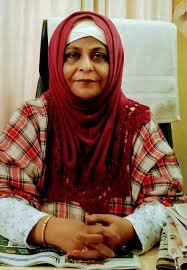
 Begum Shehnaz Sidrat is a prominent Indian social reformer and the dynamic president of Bazm-e-Khawateen, Lucknow’s oldest and most influential Muslim women’s organisation. For decades, she has been a pivotal voice in the movement for Muslim women’s rights, championing their empowerment through a progressive and rights-based interpretation of Islam.
Her commitment to social justice is deeply rooted in a formidable family legacy. Born in Moradabad and holding a postgraduate degree in Political Science and Urdu, she married into the esteemed Ansari family of Lucknow. Her father-in-law was the renowned freedom fighter, writer, and Member of Parliament Hayatullah Ansari, and her mother-in-law, Begum Sultana Hayat, founded Bazm-e-Khawateen in 1934. This environment, steeped in India’s independence movement and social reform, profoundly shaped her path.
Taking the helm of Bazm-e-Khawateen in 1992, Sidrat has worked tirelessly to dismantle patriarchal structures from within the community. Her core belief is that Islam guarantees women equal rights, which have been obscured by male-dominated interpretations. One of her most notable acts is leading public, collective prayers for women, a practice traditionally reserved for men, thereby asserting women’s right to participate fully in religious life. Her monthly gatherings at Lucknow’s Zanana Park provide a crucial safe space for women to find solidarity, receive counselling, and organise for social change.
Under her leadership, Bazm-e-Khawateen has implemented a host of programs aimed at tangible empowerment. The organisation’s educational wing, “All India Taaleem Ghar,” has trained a vast number of teachers, fostering educational upliftment across the community. Sidrat has also personally mediated thousands of marital disputes, offering crucial legal aid and counselling that have protected women’s rights. Furthermore, vocational training and self-employment workshops run by the organisation have provided countless women with a path toward financial independence.
Her influence extends into the political sphere. In 2009, she contested the parliamentary elections to advocate for greater female representation in governance. She also works to preserve her family’s heritage through the Hayatullah Ansari Foundation. Her unwavering dedication has earned her numerous accolades, including the “HT Woman of the Year” (First Runner-Up) in 2012, the “Lady of the Millennium” award in 2011, and recognition from the Uttar Pradesh Women Commission in 2013.
In essence, Begum Shehnaz Sidrat’s legacy is that of a grassroots trailblazer. She has skillfully blended direct community intervention with a bold challenge to societal norms, creating lasting change from within and solidifying her status as a pivotal figure in the continuing struggle for women’s equality in India.