
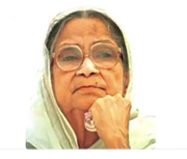
 Begum Sufia Kamal (1911–1999), born Syeda Sufia Begum, emerged as a pioneering poet, activist, and social reformer during pre-Partition India—decades before becoming a symbol of Bangladesh’s cultural nationalism. Her early journey uniquely highlights how an aristocratic Muslim woman transcended restrictive societal norms to leave a profound mark on India’s feminist and nationalist movements.
Born on June 20, 1911, in Shayestabad, Barisal (then British India), Sufia Kamal was raised in a zamindar (landowning) family, yet her life was marked by adversity after her father, a lawyer, abandoned the family for Sufi asceticism. Her mother, Sabera Begum, ensured Sufia received a rich but informal education at home: she learned Urdu, Arabic, and Persian through tutors, while her mother secretly taught her Bengali—an act frowned upon in their conservative milieu.
At age 11, she married her maternal cousin, Syed Nehal Hossain (a law student), becoming Begum Sufia Hossain. He supported her early literary interests but died of tuberculosis in 1932. In 1939, she married Kamaluddin Ahmed, after which she became widely known as Begum Sufia Kamal.
Sufia’s intellectual world expanded thanks to the family’s extensive library and the influence of her literary maternal uncle. In 1918, a pivotal encounter in Kolkata with Begum Rokeya Sakhawat Hossain, the preeminent Muslim feminist, deeply inspired her lifelong commitment to women’s education and empowerment.
During the 1920s–1940s, Sufia Kamal’s activism grew alongside India’s struggle for independence. Influenced by Mahatma Gandhi, whom she met in 1925, Sufia adopted Khadi (hand-spun cloth). She participated in the non-cooperation movement by spinning thread on the charkha, symbolising resistance to colonial economic policies. Her social engagement extended to promoting Hindu-Muslim unity and working with grassroots women’s organisations—a rare stance for a Muslim woman in that era.
She became a member of Begum Rokeya’s Anjuman-i-Khawatin-i-Islam (Muslim Women’s Association), working for women’s social uplift and education, and in 1931 was the first Bengali Muslim woman to join the Indian Women’s Federation, actively participating in its programs. Her leadership extended to humanitarian relief during communal violence, notably during the vicious Calcutta riots of 1946, where she helped manage shelters for victims.
Sufia Kamal’s pre-Partition writings—short stories and poems published in Bengali journals—emphasised women’s agency, social justice, and the challenges faced by Muslims and women in the subcontinent under colonial rule. Her first poetry collection, “Sanjher Maya” (1938), established her as a leading voice for Muslim women in Bengal, earning endorsements from Rabindranath Tagore and Kazi Nazrul Islam.
During the 1971 Liberation War, Sufia Kamal demonstrated extraordinary courage and commitment to Bangladesh’s independence despite being confined to her Dhanmondi residence by the Pakistani Army. Her role during the nine-month conflict was multifaceted and dangerous. Despite continuous threats from Pakistani military forces, Sufia provided crucial support to the Mukti Bahini (freedom fighters) from her house.
Sufia meticulously documented the horrors of 1971 in her manuscript “Ekatturer Diary” (Diary of ’71), which became one of the most important firsthand accounts of the Liberation War. Published in 1989, this work provides invaluable historical testimony about the genocide and resistance during Bangladesh’s birth.
Sufia Kamal received nearly fifty major awards during her lifetime, reflecting her extraordinary contributions to literature, women’s rights, and social justice.