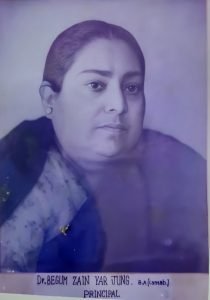
 Begum Zain Yar Jung (born Ruqaiya “Lulu” Bilgrami; c. 1905–1968) was a transformative figure in the educational and social landscape of princely Hyderabad. Born into the illustrious Bilgrami family—a dynasty of intellectuals and advisors to the Nizam—she was the granddaughter of the polymath Nawab Syed Husain Bilgrami. Her upbringing in such a scholarly environment, combined with her marriage to the state’s Chief Architect, Nawab Zain Yar Jung, positioned her at the heart of Hyderabad’s modernising elite. In 1933, she became one of the few Indian Muslim women of her era to earn a degree from the University of Cambridge, a distinction that would inform her lifelong mission to dismantle the cultural and systemic barriers preventing women from entering the public sphere.
Leadership at Osmania University
Upon her return to India, Begum Zain Yar Jung joined the Osmania University College for Women, where she served as Principal from 1941 to 1947. Her tenure was marked by a radical expansion of academic opportunities for women. She introduced honours courses in Political Science and English—subjects previously reserved for men’s colleges—and secured the funding necessary to build science laboratories and residential hostels. By establishing an in-house teacher-training certificate program, she created a sustainable pipeline of qualified women educators for the state’s burgeoning network of girls’ schools. Crucially, she used her influence to persuade authorities to reserve bursaries for first-generation students from conservative households, ensuring that higher education was not merely a luxury for the elite but a tool for broader social mobility.
Economic Empowerment and Social Reform
Beyond the university, the Begum was a fierce advocate for women’s economic agency. Through the Hyderabad Ladies’ Association, she established a Women’s Employment Bureau that successfully placed hundreds of women in office and nursing positions during the 1940s. In 1944, she founded the Nisa Industrial Co-operative to provide vocational training and a steady income for war widows and abandoned wives. Her educational philosophy was articulated in her published pamphlets, such as Modern Citizenship for the College Girl (1943) and Needle and Book: Twin Tools of Freedom (1945), where she argued that a combination of liberal education and vocational skill was the essential “twin tool” for female emancipation.
Recognition and Lasting Legacy
Her contributions were recognised with the Nizam’s Silver Jubilee Medal in 1946, and in 1954, she became the first woman from Hyderabad to be elected a Fellow of the Indian National Social Conference. Though she resigned her official post in 1947 when her husband was appointed the Nizam’s Agent General in Delhi, she remained a mentor to young women until her death in 1968. Today, her legacy is preserved at the University through the Begum Zain Yar Jung Rolling Trophy and “Lulu House,” the hostel block she helped establish, which continues to serve as a home for female scholars pursuing the independence she so championed.