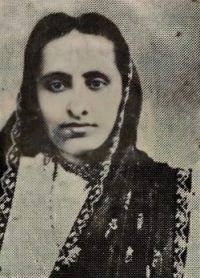
 Fatima Begum ‘Arzu’ (1879–1966) was a pioneering scholar, educationist, and social reformer who made foundational contributions to Muslim women’s education in early 20th-century India. Born in Mecca to the distinguished Islamic scholar Maulana Khairuddin, she was the sister of India’s first Education Minister, Maulana Abul Kalam Azad. This scholarly lineage provided her with a rich intellectual environment, which she leveraged to advocate for women’s empowerment.
Raised and educated under her father’s tutelage, she became a brilliant scholar in her own right. She served as his literary assistant, and as his eyesight failed with age, she became his scribe. Her skill was such that her handwriting was indistinguishable from his, allowing her to manage his manuscripts and correspondence and demonstrating her intellectual prowess from an early age.
Her most significant legacy, however, lies in her relentless advocacy for women’s education. Working closely with her sister, Hanifa Begum ‘Abru’, she emerged as one of India’s earliest feminist educationists. Her vision was not merely for basic literacy but for higher, specialised education that was compatible with women’s cultural and religious values.
This vision was powerfully articulated in a message she sent to the All India Muslim Ladies Conference in Lahore on March 4, 1918. In it, she proposed the creation of a “Jamia Islamia” (Islamic University) for women. She urged the Muslim University to establish an autonomous body dedicated to setting up schools, designing a suitable curriculum, publishing textbooks, and conducting examinations exclusively for women across India.
In a later speech as Secretary of the Anjuman Khawatin Hind in Bhopal, she argued that government schools were inadequate for Muslim girls because they lacked essential religious and moral instruction. Citing the Poona Women’s University as a model, she asserted that an independent university was crucial for Muslim women to pursue education without compromising their identity.
Putting her vision into practice, Fatima Begum played a pivotal role in the founding and development of the Aligarh Women’s College, an institution that remains a cornerstone of women’s education in the subcontinent. Her efforts extended beyond Aligarh; she was actively involved in the Women’s Conference Movement and helped establish numerous schools and hospitals throughout India. Both she and her sister, Hanifa Begum ‘Abru’, were central figures in the All-India Muslim Women’s Conference (Anjuman-i-Khawatin-i-Islam), utilising it as a platform for their activism.
A prolific writer and editor, Fatima Begum also contributed to the intellectual discourse on social reform through various publications. Her work was nationally recognised, and she was celebrated among prominent reformers for her contributions.
The transformative impact of Fatima Begum ‘Arzu’ cannot be overstated. She helped create formal educational pathways for Muslim women, challenged conservative societal norms, and built lasting institutions that continue her mission. Though historically overlooked, her legacy as a pioneering educationist who harmonised progressive reform with cultural identity is now being increasingly acknowledged.