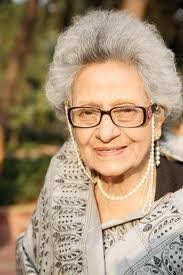
 Hamida Habibullah (1916–2018) was a trailblazing Muslim woman from India whose multifaceted contributions spanned politics, education, women’s emancipation, and societal development. Born on November 20, 1916, in Hyderabad, she hailed from an illustrious family. Her father, Nawab Nazir Yar Jung Bahadur, served as Chief Justice of the Hyderabad High Court, while her mother was Talmain Khatoon. In 1938, she married Major General Enaith Habibullah, the founding commandant of the National Defence Academy. Her mother-in-law, Begum Inam Habibullah, influenced her educational pursuits by founding Talimgah-E-Niswan College. Hamida’s son, Wajahat Habibullah, became a prominent civil servant, and her grandsons, Amar and Saif Habibullah, continued her legacy in business and social organisations.
In politics, Hamida aligned with the Indian National Congress from 1965, serving as an MLA from Haidergarh (1965–1974) and as State Minister for Social and Harijan Welfare, National Integration, Civil Defence (1971–1973), and Tourism (1971–1974) in Uttar Pradesh. She led the Uttar Pradesh Mahila Congress (1972–1976), was part of the All India Congress Committee from 1969, and sat in the Rajya Sabha (1976–1982). Her advocacy emphasised social integration and critiqued divisive politics.
Hamida earned a BA from Osmania University and received training at Whitelands College, London. She expanded Talimgah-E-Niswan College as its president from 1975, serving 3,500 underprivileged students, and led Avadh Girls’ Degree College since 1975. She contributed to Lucknow University’s Executive Council (1974–1980) and founded the Uttar Pradesh Urdu Academy (1972–1976, re-elected 1982), promoting accessible education for minority girls.
For women’s emancipation, she presided over SEWA Lucknow, empowering 5,000 artisans via chikan embroidery. She co-founded Prajwala, served on the Central Social Welfare Board (from 1987), and patronised organisations like the All India Women’s Conference and Cheshire Homes. As the first president of the Women’s Cricket Association (1973), she advanced women’s sports. Societally, she enhanced horticulture in Saidanpur, hosted dignitaries like Nikita Khrushchev, and fostered ties with the Nehru family.
She is featured in biographical works such as Apostles of Transformation and Divided by Partition: United by Resilience. She has been conferred with numerous honours, including the Chishti Harmony Award (2012), Hindustan Times Woman Lifetime Achievement Award, and Yash Bharti Award. Recognised as an icon of post-independence Indian womanhood, she passed away on 13 March 2018 at the age of 101.