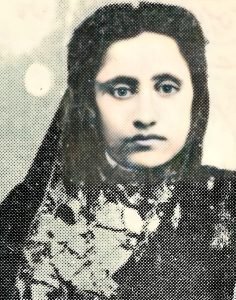
Hanifa Begum (1881–1943), known by her pen name ‘Abru’, was a pioneering Indian feminist, educationist, and social reformer in the early 20th century. A gifted orator, poet, and prose writer, she was also the sister of Maulana Abul Kalam Azad, with whom she shared an exceptionally close bond.
Born in Mecca in 1881 to the respected Sufi scholar Maulana Muhammad Khairuddin and his scholarly wife Alia Begum, Abru was raised in a family with a deep tradition of intellectual and reformist thought. The family, having left India during the 1857 War of Independence, returned to settle in Calcutta in the 1890s. Despite her formal studies being periodically interrupted by poor health, her sharp intellect and passion for learning drove her to become a profound scholar through self-study. She was known to be more socially and politically active than her sisters, Fatima Begum ‘Arzu’ and Zainab Begum, and was her brother Maulana Azad’s sole supporter during his period of intellectual and spiritual crisis.
Abru Begum’s public life was largely centred in Bhopal, where she was connected to the reformist court of the Begums of Bhopal. After her first marriage to Ahmed Ibrahim of Calcutta, she married Wajid Ali Khan, a government secretary in Bhopal. There, she served as a secretary to the Begum of Bhopal and, alongside her sister Fatima Begum ‘Arzu’, worked as an education officer in the state service, directly shaping policies to promote girls’ education and public health. A dynamic force, she established a Ladies Club in Bhopal, which met twice a week to educate women about the freedom struggle and discuss pressing social issues, including restrictive customs, women’s health, and the importance of education.
Her influence extended across the subcontinent as a founding leader of the All India Muslim Ladies’ Conference, established in 1914. Through this platform, she delivered powerful speeches on women’s education and national freedom. She was a staunch advocate for an education system for women free from the control of men, arguing that they could not fully grasp the needs of female students. Her philosophy sought to create learning environments that respected cultural sensitivities while advancing modern education.
Abru was a vocal champion for women’s rights, actively challenging practices like polygamy and seclusion (purdah). She was a prominent voice in the campaign to raise the age of consent for marriage, which culminated in the Child Marriage Restraint Act of 1929, and was instrumental in building support for the legislation among Muslim women. She also participated in the “dress controversy” of the era, advocating for practical changes in women’s attire while opposing the blind imitation of Western fashion.
In addition to her organisational and advocacy work, Abru made concrete contributions through her writings. She edited Rehbar-i-Sehat (Guide to Health), a public-education primer published in 1922, and compiled an Urdu report on a women’s handicrafts exhibition held in Bhopal in 1927.
Hanifa Begum ‘Abru’ passed away in Bhopal in June 1943, while her brother was imprisoned. Her legacy is that of a trailblazing feminist educationist who worked tirelessly to build institutions and change social attitudes at a time when Muslim women faced significant marginalisation, laying crucial groundwork for the future of women’s education in India.